
Mobile games make money in several ways, even when players can download and play them for free. From in-game advertisements and virtual purchases to subscriptions, premium downloads and brand partnerships, game developers use different monetization strategies to turn player engagement into revenue.
The most successful mobile games rarely depend on just one income source. Instead, they combine monetization methods based on their gameplay, target audience and player behavior. For example, a puzzle game might generate revenue through rewarded advertisements and extra lives, while a multiplayer strategy game may earn through subscriptions, premium features and in-app purchases.
Understanding how mobile games generate revenue is important for anyone planning to develop a gaming app or build a sustainable gaming business. The right monetization strategy can help cover development expenses, fund future updates, improve player retention and create long-term revenue opportunities.
In this guide, we explore seven popular mobile game monetization models, how they work, how to choose the right one and what developers should consider when building a profitable mobile game.
How Do Mobile Games Generate Revenue?
Mobile games generate revenue by offering players opportunities to spend money, displaying advertisements or partnering with brands. Some games charge users before downloading, while others provide free access and earn money through purchases and advertisements inside the app.
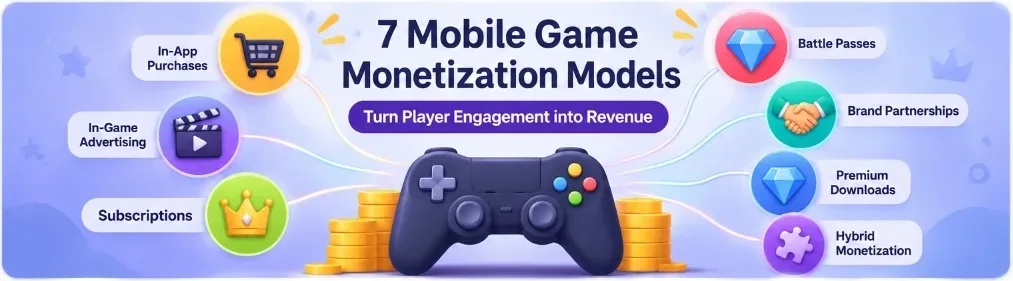
Here are the main ways mobile games make money:
In-app purchases: Selling virtual currencies, power-ups, extra lives, characters and other digital items.
In-game advertising: Displaying banner ads, video ads, interstitial ads and rewarded advertisements.
Subscriptions: Charging recurring fees for exclusive content, premium access and additional benefits.
Paid downloads: Collecting a one-time payment when users purchase the game.
Battle passes: Offering seasonal progression systems with exclusive rewards.
Brand partnerships: Generating income through sponsorships, collaborations and promotional campaigns.
Hybrid monetization: Combining multiple revenue models within one game.
The best approach depends on the game's genre, audience, engagement levels and overall business objectives. A developer should consider monetization during the planning and development stages rather than treating it as something to add after launch.
7 Popular Mobile Game Monetization Models
There is no universal monetization strategy that works for every game. Some games generate most of their income through advertising, while others rely on purchases and recurring subscriptions.
Let's explore seven widely used mobile game revenue models.
1. In-App Purchases (IAP)
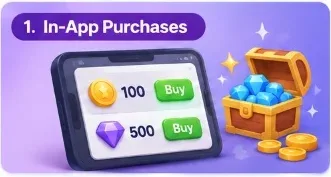
In-app purchases are one of the most popular ways to monetize free-to-play mobile games. Players can download and enjoy the game without an upfront payment, but they can purchase additional digital items or features while playing.
These purchases allow developers to generate revenue from users who want to customize their experience, unlock additional content or access optional benefits.
Common types of in-app purchases include:
Consumable purchases: Items that players use and purchase again, such as coins, gems, extra lives, energy and power-ups.
Non-consumable purchases: Permanent items such as character skins, additional levels, premium features and exclusive content.
Progression purchases: Optional upgrades or resources that help players progress through the game.
Cosmetic purchases: Skins, outfits, avatars, accessories and visual enhancements that personalize gameplay.
Example: In a puzzle game, players might purchase additional moves when they run out of attempts. In a strategy game, they might buy virtual resources to speed up construction or unlock additional customization options.
Why this model works:
Allows developers to offer free downloads and attract a larger audience.
Creates opportunities for repeat purchases.
Supports different spending preferences.
Can generate revenue from highly engaged players.
However, purchases should remain optional and provide genuine value. Making essential gameplay frustrating to encourage spending can damage player satisfaction and retention.
Also Read: Mobile Gaming Trends 2027
2. In-Game Advertising

In-game advertising allows developers to earn money by displaying advertisements to players during their gaming sessions.
Unlike paid downloads, players do not necessarily need to spend anything. Advertisers pay for ad impressions, clicks or other qualifying interactions, depending on the advertising arrangement.
This model is particularly useful for free-to-play games with a large and active user base.
Popular mobile game advertising formats include:
Banner Ads
Banner advertisements are small rectangular ads displayed at the top or bottom of the screen. They can remain visible during gameplay and provide a relatively unobtrusive advertising opportunity.
Interstitial Ads
Interstitial ads are full-screen advertisements that appear between levels, rounds or other natural breaks in gameplay. They provide more visibility but should not interrupt important gameplay moments.
Rewarded Video Ads
Rewarded advertisements allow players to watch a short video in exchange for an in-game benefit.
For example, a player might watch an advertisement to receive:
Extra lives.
Additional coins.
A bonus spin.
Extra moves in a puzzle game.
A temporary power-up.
Because players choose to watch these advertisements in exchange for something valuable, rewarded video can be a useful way to monetize non-paying users.
Native Ads
Native advertisements are designed to match the visual style and layout of the surrounding app experience. When implemented properly, they can feel less disruptive than traditional advertisements.
Playable Ads
Playable advertisements provide an interactive preview of another game. Players can try a small part of the advertised experience before deciding whether to install it.
Offerwalls
Offerwalls present players with optional promotional activities, such as completing surveys or engaging with sponsored offers, in exchange for in-game rewards.
How do mobile game ads generate revenue?
Mobile advertising revenue is commonly measured through metrics such as eCPM (effective cost per thousand impressions).
A simplified calculation is:
Advertising Revenue = (Total Ad Impressions ÷ 1,000) × eCPM
For example, if a game generates 100,000 ad impressions and achieves an eCPM of $5, the estimated advertising revenue would be $500.
This is an illustrative calculation, not a guaranteed advertising rate. Actual earnings depend on factors such as player location, ad format, advertiser demand, fill rate and engagement.
3. Subscription-Based Monetization

Subscriptions allow mobile game developers to generate recurring revenue by charging players weekly, monthly or annually for premium access and additional benefits.
Instead of making individual purchases, players pay a recurring fee to access selected features throughout their subscription period.
Common subscription benefits include:
Ad-free gameplay.
Exclusive characters and customization options.
Daily login bonuses.
Premium game modes.
Additional rewards.
Exclusive tournaments or events.
Access to special content.
Example: A multiplayer gaming platform could introduce a premium membership that offers an ad-free experience, exclusive profile customization, additional statistics and other optional benefits.
There are two common subscription structures:
Auto-renewing subscriptions: Automatically renew after each billing period unless cancelled.
Fixed-term subscriptions: Provide access for a specific period and require manual renewal.
Why subscriptions work:
Subscriptions can create predictable recurring revenue, especially when a game consistently provides fresh content and meaningful benefits.
However, developers must continue delivering value. If players feel that a subscription does not justify its price, cancellation rates can increase.
Also Read: Key Features of Gamification in Mobile Apps
4. Hybrid Monetization Model

The hybrid monetization model combines multiple revenue streams within the same mobile game.
Rather than relying entirely on advertisements, purchases or subscriptions, developers create different ways to generate revenue from different player segments.
For example, a free-to-play puzzle game could:
Display rewarded advertisements for additional moves.
Offer optional in-app purchases for extra lives.
Sell cosmetic customization options.
Introduce a monthly premium subscription.
Run limited-time promotional events.
This gives players more flexibility. Someone who does not want to spend money can continue playing through advertisements, while another player may prefer purchasing premium items.
Why hybrid monetization is effective:
Diversifies revenue sources.
Reaches both paying and non-paying players.
Reduces dependence on a single monetization method.
Creates more opportunities to improve player lifetime value.
Allows developers to test different revenue strategies.
The important part is maintaining balance. Combining monetization methods should not mean filling every screen with advertisements or purchase prompts.
The objective is to generate revenue without compromising the experience that makes people want to play.
5. Premium or Paid Game Downloads

The premium model is one of the simplest mobile game revenue models.
Players pay a one-time fee to download and access the game. Unlike free-to-play games, premium games do not necessarily need advertisements, subscriptions or additional purchases to generate their primary revenue.
Examples include:
Minecraft.
Monument Valley.
The Room.
These games demonstrate that players are willing to pay upfront for a distinctive and valuable gaming experience.
Advantages of premium game monetization:
Direct revenue from each purchase.
No need to depend on advertising impressions.
A straightforward payment structure.
An uninterrupted gaming experience when no additional monetization is included.
Challenges:
Convincing users to pay before trying a game can be difficult, especially when many competing games are free to download.
This model is generally more suitable for games with strong gameplay, distinctive features, an established audience or a compelling premium experience.
Also Read: Top 20 Mobile Game Genres
6. Battle Passes and Meta Layer Monetization
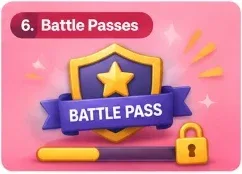
Modern mobile games increasingly generate revenue through additional features built around the core gameplay.
This is often called meta layer monetization. It involves introducing optional progression, customization, social and seasonal systems that give players more reasons to stay engaged.
One popular example is the battle pass.
A battle pass provides a structured reward system where players complete missions, challenges or gameplay activities to unlock rewards.
A typical battle pass may include:
A free reward track.
A premium reward track.
Seasonal challenges.
Exclusive character skins.
Special profile items.
Limited-time collectibles.
Players can purchase the premium version to unlock additional rewards while progressing through the game.
Other meta layer monetization opportunities include:
Cosmetic shops.
Seasonal events.
Limited-time offers.
Avatar customization.
Achievement-based rewards.
Social competitions.
Special progression systems.
Example: A multiplayer game could introduce a 30-day seasonal challenge where players complete missions to unlock exclusive cosmetic items. The basic experience remains accessible, while premium rewards provide an additional purchase opportunity.
This model is especially useful for games that have an active community and regular content updates.
7. Sponsorships, Brand Partnerships and Collaborations

Mobile games can also generate revenue through partnerships with brands, advertisers and other businesses.
Instead of depending entirely on individual player purchases, developers can monetize their audience by providing promotional opportunities to external companies.
Some common partnership opportunities include:
Sponsored in-game events.
Branded challenges.
Product placements.
Sponsored tournaments.
Exclusive promotional rewards.
Brand-themed characters or digital items.
Cross-promotional campaigns.
Example: A sports-themed mobile game could collaborate with a sportswear brand to introduce a limited-time branded event. The brand receives promotional visibility, while the game developer receives sponsorship revenue.
This approach can be particularly useful for games with a strong audience, recognizable identity or active player community.
The partnership should feel relevant to the game rather than like an unrelated advertisement.
Also Read: Artificial Intelligence in Game Development
How Do Free-to-Play Mobile Games Make Money?
Free-to-play games are available to download without an upfront purchase. However, free access does not mean that the developer earns nothing.
Instead, these games generate revenue through optional purchases, advertising, subscriptions and other monetization methods.
Consider a simple example of a free-to-play puzzle game.
A player downloads the game and starts playing without paying anything. After completing several levels, they run out of moves. The game offers an optional rewarded advertisement to receive additional moves.
Another player might choose to purchase extra lives instead of watching an advertisement. A highly engaged player could also purchase a premium subscription to remove advertisements and unlock additional benefits.
All three players contribute differently to the game's revenue model.
This is why free-to-play games focus on building an engaging experience that encourages users to return regularly.
The key revenue opportunities in free-to-play games include:
Advertising revenue from active players.
In-app purchases from players who want additional benefits.
Subscription revenue from users who prefer premium access.
Sponsorship revenue from brand collaborations.
Seasonal purchases through special events and battle passes.
A successful free-to-play business model focuses on attracting players, retaining them and providing optional purchases that enhance their experience.
Which Mobile Game Monetization Model Is Best for Different Game Genres?
Not every mobile game should use the same revenue strategy. The right model depends on gameplay mechanics, session length, audience behaviour and the type of value players receive.
Here is a practical comparison:
Mobile game genre | Recommended primary model | Additional model |
Hyper-casual games | In-game advertising | Light in-app purchases |
Puzzle games | In-app purchases | Rewarded advertisements |
Casual games | Hybrid monetization | Subscriptions |
Strategy games | In-app purchases | Battle passes |
Multiplayer games | Hybrid monetization | Premium memberships |
Role-playing games | In-app purchases | Subscriptions |
Educational games | Subscriptions | Advertising |
Card and board games | Advertising | Cosmetic purchases |
These are general recommendations rather than fixed rules. Actual performance depends on the individual game and its audience.
For example, a simple puzzle game with short play sessions may benefit from rewarded advertisements. A multiplayer strategy game with long-term progression may have more opportunities for subscriptions, virtual goods and seasonal passes.
The best monetization strategy is the one that fits naturally into the gameplay.
How Much Money Can a Mobile Game Make?
Mobile game revenue varies significantly. Some games generate modest income, while successful titles can become substantial businesses.
There is no fixed amount that a game earns per download or active player.
Revenue depends on several factors:
1. Number of Active Players
A larger active audience creates more opportunities for advertising impressions, purchases and subscriptions.
However, downloads alone do not guarantee revenue. What matters is how many users continue playing.
2. Player Engagement
Players who return frequently create more opportunities for monetization.
Daily active users, session frequency and average session duration can help developers understand engagement.
3. Monetization Conversion Rate
Not every player makes a purchase. The percentage of users who become paying customers is an important indicator of in-app purchase performance.
4. Geographic Location
Player spending behaviour and advertising demand vary across countries and regions.
A game may generate different advertising and purchase revenue from users in India, the United States, the United Kingdom and other markets.
5. Retention Rate
Retention measures how many players return to the game after their first visit.
Strong retention gives developers more opportunities to build long-term relationships with players and generate recurring revenue.
6. User Acquisition Costs
Developers often invest in advertising and marketing to acquire new players. These expenses must be considered when calculating profitability.
A game can generate substantial revenue but still be unprofitable if its acquisition and operating costs are too high.
Understanding the Important Mobile Game Revenue Metrics
To understand whether a game is generating healthy revenue, developers should monitor more than total earnings.
Here are some important mobile game monetization KPIs:
Metric | Meaning |
ARPU | Average Revenue Per User |
ARPPU | Average Revenue Per Paying User |
ARPDAU | Average Revenue Per Daily Active User |
LTV | Lifetime Value of a player |
CPI | Cost Per Install |
Retention Rate | Percentage of players who return |
Churn Rate | Percentage of players who stop using the game |
Conversion Rate | Percentage of users who complete a desired action |
eCPM | Effective revenue per 1,000 ad impressions |
Why are these metrics important?
They help developers identify which monetization methods are working, which player segments generate revenue and where improvements are needed.
For instance, a game might attract thousands of downloads but have poor retention. In that situation, increasing advertising spend alone may not solve the problem.
Improving onboarding, gameplay quality and player engagement could create better long-term results.
Also Read: Complete Guide to the Game Development Process
Common Mobile Game Monetization Mistakes to Avoid
Even a well-designed game can struggle financially if its monetization strategy is poorly implemented.
Here are some common mistakes developers should avoid:
Showing too many advertisements: Excessive ads can interrupt gameplay and reduce player satisfaction.
Ignoring non-paying players: Players who do not make purchases can still contribute advertising revenue and help build an active community.
Making purchases feel compulsory: Optional purchases should enhance the experience, not make the basic game unnecessarily frustrating.
Choosing the wrong monetization model: A subscription-heavy strategy may not suit a simple game with limited ongoing content.
Ignoring retention: Acquiring new users is not enough if existing players stop returning.
Not tracking revenue metrics: Without analytics, developers cannot accurately understand which monetization methods are performing well.
Ignoring regional differences: A pricing strategy that works in one country may not work equally well in another.
How GameNexa Helps Businesses Build Revenue-Generating Mobile Games
Building a successful mobile game requires more than an engaging concept. It also requires the right development approach, monetization planning, user experience and long-term growth strategy.
At GameNexa, we help businesses transform their gaming ideas into mobile gaming experiences designed around their objectives and target audiences.
Our mobile game development capabilities cover the different stages of building a gaming product, including:
Mobile Game Development: Creating engaging games for Android and iOS platforms.
Multiplayer Game Development: Building competitive and social gaming experiences.
Unity Game Development: Developing interactive 2D and 3D gaming experiences using Unity.
Game UI/UX Design: Creating intuitive interfaces that make gameplay easy to understand and enjoyable.
Game Monetization Integration: Implementing suitable advertising, in-app purchase and other monetization features based on project requirements.
Game Testing and Optimization: Testing gameplay, performance and functionality across supported devices.
Whether you want to develop a casual puzzle game, a multiplayer gaming platform or a feature-rich gaming application, the right monetization approach should be considered from the beginning.
Planning to build a mobile game?
Partner with GameNexa to turn your idea into a gaming product built around your business goals.
Frequently Asked Questions About Mobile Game Monetization
1. How do mobile games generate revenue?
Mobile games generate revenue through in-app purchases, advertisements, subscriptions, premium downloads, battle passes and brand partnerships. Many successful games combine multiple monetization methods to generate income from different types of players.
2. How do free mobile games make money?
Free mobile games make money by displaying advertisements, selling virtual items, offering premium subscriptions and providing optional in-game purchases. Players can access the basic game without paying, while developers earn revenue through these additional opportunities.
3. What is the most profitable mobile game monetization model?
There is no single most profitable model for every game. In-app purchases can work well for games with strong progression systems, advertisements can suit casual games with frequent sessions, and subscriptions can benefit games with regular premium content. Hybrid monetization can provide additional revenue opportunities.
4. How do mobile game advertisements generate revenue?
Mobile game advertisements generate revenue when players view, interact with or complete qualifying advertising actions. Developers commonly earn through banner ads, interstitial ads, rewarded video advertisements and other formats. Actual revenue depends on impressions, eCPM, audience location and advertising demand.
5. What is hybrid monetization in mobile games?
Hybrid monetization combines multiple revenue models, such as in-app purchases, rewarded advertisements and subscriptions. It allows players to choose how they interact with optional monetization features while giving developers more than one income source.
6. What is ARPDAU in mobile gaming?
ARPDAU stands for Average Revenue Per Daily Active User. It measures the average revenue generated by each daily active user over a particular period. It is calculated by dividing total revenue by the number of daily active users for that period.
7. What is player lifetime value (LTV)?
Player lifetime value estimates the total revenue a game can generate from a player throughout their relationship with the game. It helps developers evaluate long-term monetization performance and understand how much they can reasonably invest in acquiring new players.
8. How can game developers increase mobile game revenue?
Developers can improve revenue by increasing player retention, optimizing advertisements, introducing valuable in-app purchases, testing pricing strategies, personalizing offers and introducing engaging live events. The focus should be on improving monetization without damaging the player experience.
9. Can multiplayer mobile games generate revenue?
Yes. Multiplayer mobile games can earn money through advertisements, in-app purchases, subscriptions, cosmetic items, battle passes, sponsored tournaments and brand partnerships. The best approach depends on the game's audience, competitive structure and engagement levels.
10. When should monetization be planned during mobile game development?
Monetization should be considered during the initial planning and game design stages. This allows developers to build suitable systems into the gameplay, user interface and technical architecture instead of adding them as an afterthought.
Final Thoughts
Mobile game monetization is not simply about placing advertisements or selling virtual items. It is about creating a sustainable business model that connects player engagement with revenue opportunities.
From in-app purchases and rewarded advertisements to subscriptions, battle passes and brand partnerships, developers have several ways to monetize their games.
The key is to understand the target audience, choose suitable revenue models and continuously improve the experience using real player data.
A well-planned monetization strategy, combined with engaging gameplay and consistent updates, can help turn a mobile game into a sustainable business.