


Artificial intelligence, personalized gameplay, multiplayer adventures, evolving monetization strategies and new game discovery approaches will define the mobile gaming landscape in 2027. At the same time, mobile game developers will have to pay closer attention to platform policies, player retention, privacy and regional market differences.
Businesses that are planning to launch a mobile game can learn a lot from these trends to choose the right features, manage the development cost, and build a sustainable gaming product.
In this guide, GameNexa explores 12 mobile gaming trends to watch in 2027, including what each trend means, potential business benefits, and how developers might prepare.
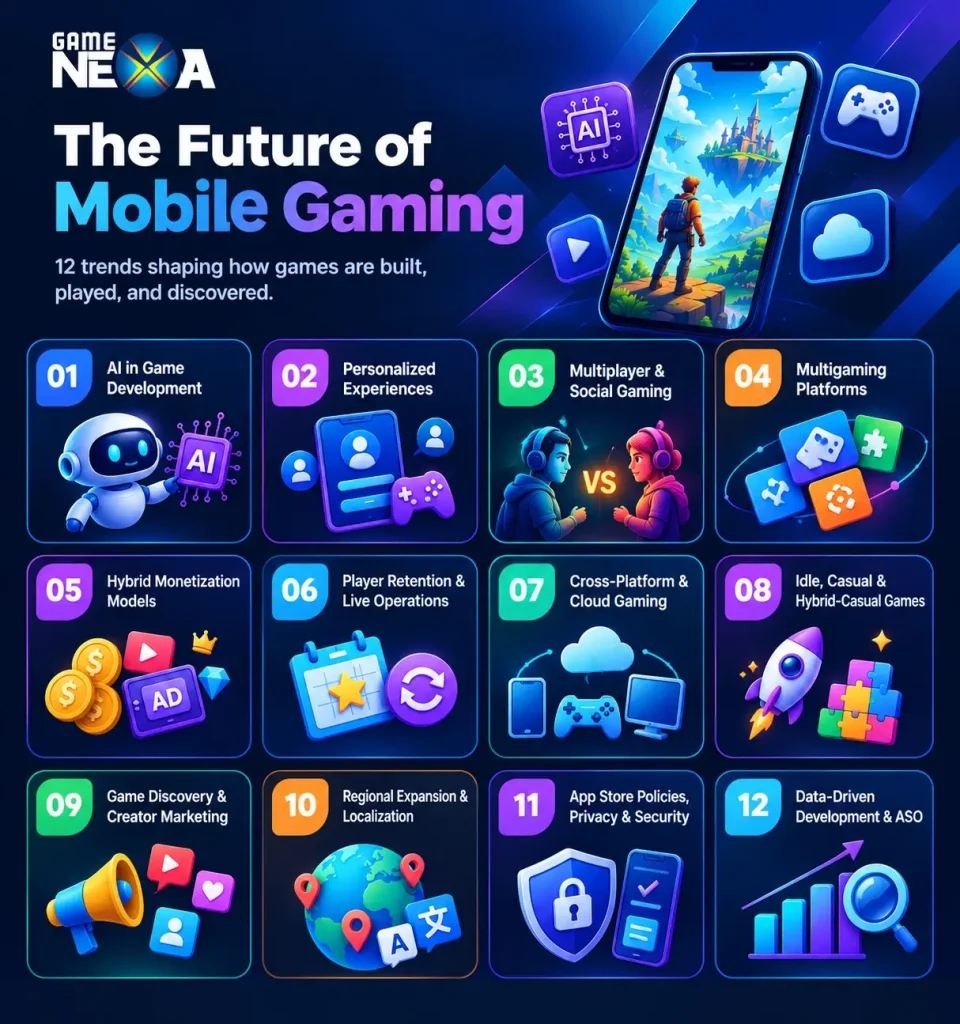
Top Mobile Gaming Trends in 2027
Check out these big mobile gaming trends for 2027:
- Artificial intelligence for game development
- Personalized gaming experience
- Social and multiplayer gaming .
- Multi-gaming gateways
- Hybrid models for monetization
- Live ops and player retention
- Cloud gaming and cross-platform play
- Casual, idle and hybrid casual games
- Game discovery & creator marketing
- Localization and regional market development
- App Store Policies, Privacy and Security
- Data-driven development and optimization of the app store
Not all of these trends are equally important for each game. Developers should concentrate on those that fit their audience, budget, genre, and business model.
1. Mobile Game Development with Artificial Intelligence
Artificial Intelligence (AI) is an invaluable instrument for game development. By 2027 developers will probably explore AI-assisted testing, content generation, gameplay personalization and player support.
While artificial intelligence can increase team efficiency, it is not a substitute for talented developers, designers and quality assurance professionals.
How AI can improve mobile games
- Automated Testing: Discover bugs, crashes and performance issues.
- AI-assisted content generation: Assistance with early ideas for characters, environments, and dialog.
- More intelligent game characters: Make computer-controlled opponents more reactive in appropriate games.
- Personalized gameplay: Recommend challenges based on the player’s progress.
- Player support: Help categorize frequently asked questions and support tickets.
For example, a puzzle game might leverage analytics in order to discover levels that many players struggle with. Developers are able to review difficulty and modify level design.
But content produced by AI requires human review for originality, quality, licensing and intellectual property concerns. Businesses should also protect player data and not generate unfair benefits via automated systems.
What developers should do: Start working on practical applications, like automated testing or prototyping, before spending money on expensive AI features that may not improve the player experience.
2. Personalized Gaming Experiences
Personalization allows games to respond to different player preferences and abilities. Beginners may need simple tutorials, while experienced players may prefer advanced challenges.
Mobile games can offer personalized recommendations, optional tutorials, progress-based challenges, and suitable difficulty adjustments.
For example, a multigaming platform could recommend a beginner-friendly puzzle game to a new user and introduce more challenging games as the user explores the app.
Personalization can improve engagement, but it should not pressure players to spend money or play excessively. Developers should collect only necessary data and provide appropriate privacy controls.
3. Multiplayer Gaming and Real-Time Competition
Multiplayer gaming allows users to compete or cooperate with other players. Features such as head-to-head matches, team challenges, leaderboards, and friends lists can make games more interactive.
Important multiplayer game development features include:
- Skill-appropriate matchmaking
- Reliable real-time connections
- Friends lists and invitations
- Global and private leaderboards
- Match history and player statistics
- Anti-cheat systems and reporting tools
For example, a skill-based puzzle game could allow two players to compete in the same challenge and compare their scores.
A successful multiplayer game requires more than connecting players. Developers must also consider latency, server costs, matchmaking quality, account security, and fair competition.
Business opportunity: Multiplayer features can help businesses create more engaging gaming products, provided the underlying technology and gameplay are reliable.
4. Multigaming Platforms and Connected Game Experiences
A multigaming platform is an app or linked experience that brings together a collection of games. Players can try out a variety of titles without needing to download a separate app for each one.
This model can be very useful for companies who want to offer puzzle games, casual games, card games and multiplayer challenges through a single platform.
Why businesses may consider a multigaming platform
- Offer players more variety.
- Introduce users to relevant games within the same app.
- Share selected features, such as accounts and leaderboards.
- Run platform-wide events and promotions.
- Analyze engagement across different games.
For example, a platform could offer block puzzles, card games, and multiplayer challenges through one application.
But companies will need to plan carefully for navigation, performance, account management and game quality. Maybe a tight collection of well-designed games is a better place to start than to launch too many titles.
5. Hybrid Monetization Models for Mobile Games
Mobile game monetization refers to how a game generates revenue. In 2027, businesses should continue evaluating which combination of monetization methods best suits their audience.
| Monetization model | How it works | Main consideration |
| In-app advertising | Displays ads to generate revenue | Avoid excessive interruptions |
| In-app purchases | Offers optional digital items or features | Make purchases clear and appropriate |
| Subscriptions | Charges recurring fees for defined benefits | Provide continuing value |
| Premium downloads | Charges users to download a game | Demonstrate value before purchase |
| Hybrid monetization | Combines compatible revenue models | Balance revenue and player experience |
For example, a free puzzle game might offer optional rewarded ads and a paid ad-free option.
What is right depends on genre, audience, market and game design. Instead of assuming that one model will work for every game, developers should track retention, revenue per active user, conversion rates, and player feedback.
6. Player Retention and Live Operations
Player retention is the ability of a game to retain users who have installed or played it. Downloads may be sexy, but sustainable engagement is what fuels a sustainable gaming business.
Developers can improve retention through:
-
- Simple onboarding
-
- Meaningful progression
-
- Regular content updates
-
- Daily or weekly challenges
-
- Reliable customer support
-
- Bug fixes and performance improvements
Live operations, commonly called LiveOps, refers to managing and improving a game after launch.
Examples include seasonal events, new levels, leaderboard competitions, limited-time modes, and community challenges.
A casual gaming app could introduce a weekend challenge that lets players test their skills and compare results.
Developers should measure day-one, day-seven, and day-thirty retention to understand player behavior. Engagement should be earned through enjoyable gameplay rather than excessive notifications or manipulative reward systems.
7. Cross-Platform Gaming and Cloud Gaming
Cross-platform gaming allows supported experiences to connect players or synchronize progress across different devices and operating systems. Cloud gaming streams a game from remote servers instead of running all the game processing locally.
These technologies may create opportunities for particular games, but they serve different purposes.
Cross-platform features may include shared accounts, synchronized progress, and compatible multiplayer matchmaking. Cloud gaming may make selected demanding games accessible on devices with less powerful hardware.
However, cloud gaming depends on network quality, latency, data usage, server availability, and infrastructure costs. It may not be necessary for casual games that run well on smartphones.
What developers should do: Evaluate cross-platform support or cloud gaming only when it solves a specific problem for the target audience.
8. Idle, Casual, and Hybrid-Casual Games
Idle games allow progress to continue automatically or with limited interaction. Casual games generally offer accessible gameplay, while hybrid-casual games combine simple mechanics with deeper progression systems.
These genres provide different ways to attract players and encourage repeat play.
| Game type | Typical experience | Development consideration |
| Idle games | Progress with limited active input | Balance progression and rewards |
| Casual games | Simple, accessible gameplay | Make the core experience easy to learn |
| Hybrid-casual games | Simple gameplay with deeper progression | Add features without creating unnecessary complexity |
For example, a block puzzle could feature unlockable themes, achievements and optional challenges to provide more long-term goals.
Businesses need to validate their audience and monetization strategy prior to selecting a genre. More features are not necessarily better retention.
9. Finding Games and Marketing By Creators
As more games hit the market, it’s even more important to help the players find a new title. A great game idea alone won’t get you downloads.
Developers are able to assist with discovery through App Store Optimization, social media, creator partnerships, community building, and referral campaigns.
Useful activities include:
-
- Researching relevant app store keywords.
-
- Creating clear screenshots and preview videos.
-
- Publishing short gameplay clips.
-
- Working with suitable gaming creators.
-
- Encouraging genuine reviews and feedback.
-
- Improving store listing conversion.
-
- Tracking acquisition costs and player retention.
For example, a mobile puzzle game could publish short videos showing interesting challenges and invite creators to demonstrate gameplay.
Marketing should attract the right audience, not just generate installs. Developers need to evaluate whether acquired players continue playing and whether acquisition costs make business sense.
10. Regional Market Expansion and Localization
Mobile gaming opportunities differ between countries. Player preferences, purchasing power, payment methods, advertising conditions, device capabilities, and local regulations can affect a game’s performance.
Localization involves adapting a game and its marketing for a particular market. It may include translating content, adjusting user interfaces, supporting local payment preferences, and creating culturally appropriate promotions.
For example, a developer launching in multiple countries may need different languages, customer support arrangements, and monetization approaches.
Businesses should not assume that a successful strategy in one market will work everywhere.
What developers should do: Select target markets based on audience demand, competition, acquisition costs, technical requirements, and legal considerations. Expand in phases and evaluate results before committing to a wider launch.
11. App Store Policies, Privacy, and Security
Mobile game development involves ongoing platform requirements, including compatibility, account security, privacy, age-appropriate experiences, and payment policies.
Google Play and the Apple App Store have their own requirements, and rules may change over time. Developers must verify the latest official guidance before launch and during ongoing maintenance.
Important areas include:
-
- Keeping supported operating system requirements up to date.
-
- Maintaining secure authentication and account recovery.
-
- Following relevant privacy and data collection requirements.
-
- Providing age-appropriate experiences where required.
-
- Reviewing payment and external purchase policies.
-
- Protecting games against cheating and suspicious activity.
For competitive games, transparent scoring and reliable results are especially important. Where a game offers prizes or uses regulated mechanics, businesses should also review the laws applicable to each target market.
12. Data-Driven Development and App Store Optimization
Game analytics helps developers understand how users discover, play, and return to a game. App Store Optimization (ASO) improves a game’s visibility and conversion on app marketplaces.
Important metrics include:
| Metric | What it helps measure |
| Downloads | Acquisition volume |
| Daily active users | Daily engagement |
| Retention rate | How many players return |
| Session length | Time spent per session |
| Store conversion rate | How effectively store visitors install |
| Crash rate | Technical reliability |
| Lifetime value | Estimated long-term player value |
For example, if many users install a game but leave during onboarding, developers can investigate registration steps, loading speed, and tutorials.
ASO activities include keyword research, clear app titles and descriptions, quality screenshots, localization, and monitoring store performance.
Combining analytics with ASO helps businesses understand both how players discover a game and whether the experience meets their expectations.
Mobile Gaming Trends in 2027: What Should Businesses Prioritize?
Not every trend deserves investment in every project. The right choice depends on the game, target audience, budget, and business objectives.
| Business goal | Trends to prioritize | What to measure |
| Improve development efficiency | AI-assisted testing | Testing time and defect rates |
| Build competitive gameplay | Multiplayer and fair play | Match quality and connection reliability |
| Create a multi-game product | Multigaming platforms | Cross-game engagement and retention |
| Improve revenue | Suitable monetization models | Revenue, conversion, and retention |
| Reach new markets | Localization and ASO | Store conversion and acquisition costs |
| Improve long-term engagement | LiveOps and progression | Return rates and player feedback |
| Reduce technical issues | Analytics and testing | Crash rates and performance |
A practical 90-day plan for mobile game businesses
Days 1–30: Research and planning
Define the target audience, review competitors, select the core gameplay, estimate development costs, and identify applicable platform requirements.
Days 31–60: Development and validation
Build or improve the core experience, test performance, review onboarding, implement appropriate analytics, and validate the monetization approach.
Days 61–90: Launch preparation and improvement
Prepare store listings, conduct device testing, plan marketing activities, review compliance, and establish a process for monitoring feedback and post-launch updates.
This is an illustrative planning framework, not a guaranteed launch timeline. Actual schedules depend on game complexity, team size, and project readiness.
How GameNexa Can Help with Mobile Game Development
Building a gaming product requires careful planning across game design, development technology, user experience, testing, monetization, and ongoing improvements.
GameNexa works in mobile game development and gaming technology, helping businesses explore the requirements of mobile games and gaming platforms.
Whether you are planning a casual game, a multiplayer experience, or a multigaming platform, your development strategy should match your audience, budget, and long-term business goals.
Planning to build your own mobile game or gaming platform? Contact GameNexa to discuss your project requirements.
Frequently Asked Questions
What are the biggest mobile gaming trends in 2027?
Key trends include AI-assisted development, personalized gameplay, multiplayer gaming, multigaming platforms, hybrid monetization, player retention, LiveOps, cross-platform experiences, localization, and stronger privacy and security.
How will AI impact mobile game development in 2027?
AI can help developers with testing, prototype creation, content workflows, personalization, and player support. Human review remains important for quality, originality, and fair gameplay.
What is a multigaming platform?
A multigaming platform brings several games together in one app or connected experience, potentially sharing accounts, leaderboards, and selected engagement features.
What is hybrid monetization in mobile games?
Hybrid monetization combines compatible revenue models, such as advertising, in-app purchases, subscriptions, or premium access.
Why is player retention important for mobile games?
Retention measures how many players return after a defined period. It helps developers assess whether their game provides lasting value beyond initial downloads.
What is LiveOps in mobile gaming?
LiveOps involves ongoing game management after launch through updates, seasonal events, challenges, new content, and other activities.
Will cloud gaming replace mobile game apps?
Not entirely. Cloud gaming may suit selected high-performance games, while native mobile apps remain practical for many casual, puzzle, and multiplayer experiences.
How can businesses improve mobile game discoverability?
Businesses can improve discoverability through ASO, relevant keywords, compelling store visuals, creator partnerships, social media marketing, and continuous analysis of store conversion.
How much does mobile game development cost in 2027?
Costs depend on game complexity, graphics, platforms, multiplayer features, backend infrastructure, testing, and maintenance. A reliable estimate requires a defined feature list and project scope.
How can a business choose the right mobile game development company?
Evaluate relevant experience, portfolio, technical expertise, testing standards, maintenance support, timelines, costs, and ownership of source code and assets.
Final Thoughts
In 2027, mobile gaming will offer opportunities for companies that blend captivating gameplay with solid technology, smart monetization and smart marketing.
Worth checking out AI, multiplayer experiences, multigaming platforms, player retention, regional expansion and game discoverability. The best way is to look for trends that address actual problems for your audience and not to follow technology just because it’s trendy.
With careful planning, meaningful analytics and continuous improvement, businesses can build mobile gaming products that are designed for a competitive and changing market.