
Introduction
Every great game starts as a messy idea. A few months later, it’s on millions of phones and screens. What happens in between? A lot, and most of it is invisible to players.
That hidden work is the game development process. It’s the path every game follows from a first idea to launch day and beyond. Teams that follow it ship better games, on time and on budget. Teams that skip steps usually learn the hard way.
This guide walks you through all seven stages in plain language. You’ll see what happens in each one, who does the work, what can go wrong and how to avoid it.
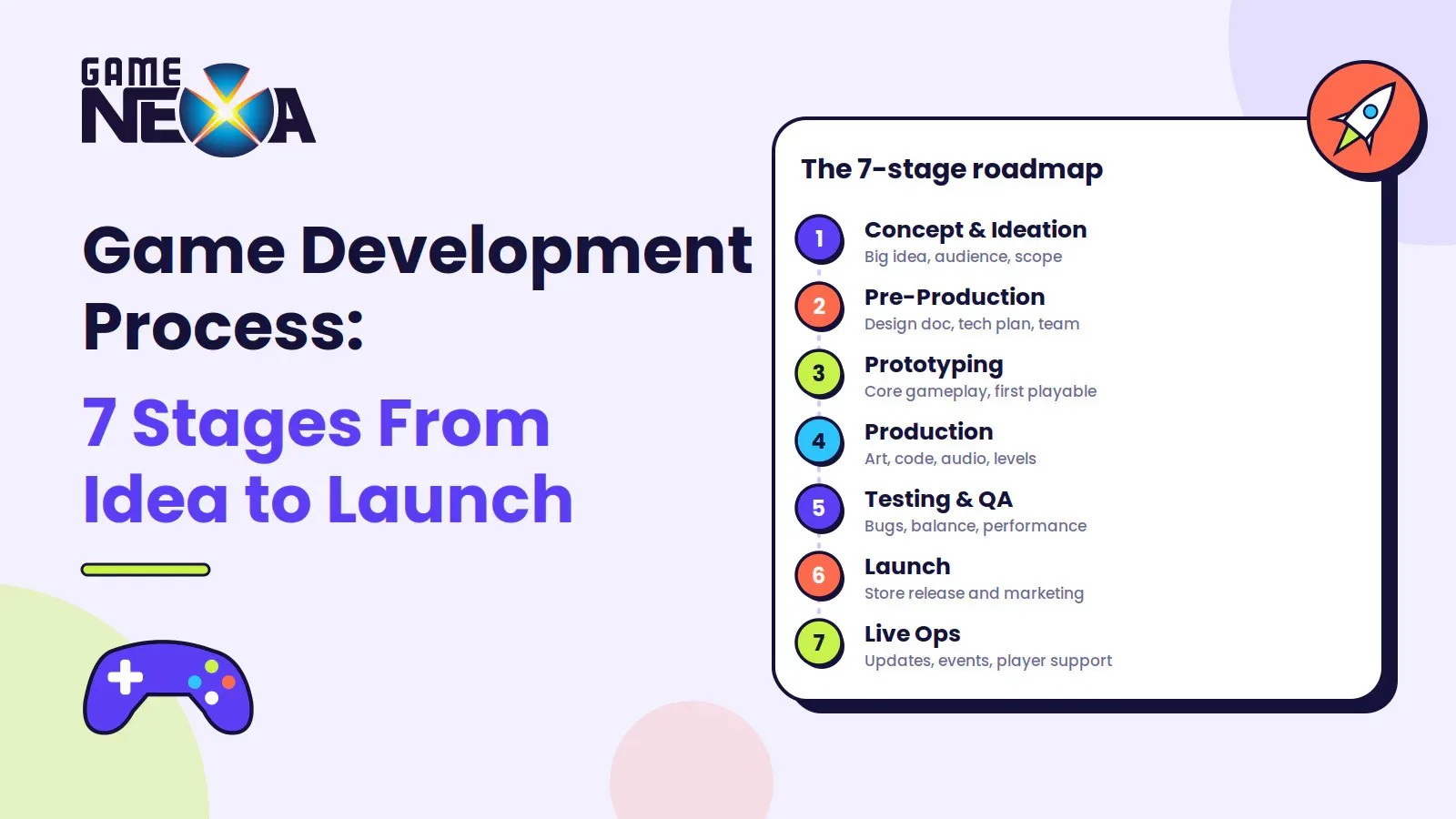
The game development process has seven stages: (1) idea and planning, (2) pre-production, (3) production, (4) testing, (5) pre-launch, (6) launch and (7) post-launch. Production takes the most time, usually 50 to 60% of the project.
Why the Game Development Process Matters More Than Ever
The games market is huge, and it’s getting harder to stand out. Newzoo forecasts the global games market at $213.9 billion in 2026, up 6.1% from last year. Mobile is the biggest slice at $121.1 billion, about 57% of the total. There are around 3.7 billion players worldwide.
But here’s the catch. According to Newzoo, global mobile downloads fell 25% in the first half of 2026, and the cost to get one install rose about 30% to $0.56. Newzoo also says future growth will depend more on keeping and monetizing existing players than on finding new ones.
What does that mean for you? Players are harder to win and easier to lose. You can’t launch a half-ready game and hope for the best. A clear process helps you:
Find problems early, when they’re cheap to fix
Avoid building features nobody wants
Keep your budget and schedule under control
Launch a game that players actually stay with
The Game Development Process at a Glance
Here’s the whole journey on one page. The time shares come from published studio guides and vary from project to project.
Stage | What happens | Key result | Share of project time |
|---|---|---|---|
1. Idea and planning | Define the game, audience, budget and team | A clear plan | Part of the 10 to 15% for planning and pre-production |
2. Pre-production | Write the design document, build a prototype, pick the tech | A tested concept | Part of the 10 to 15% for planning and pre-production |
3. Production | Build the game: code, art, levels, sound | A playable game | 50 to 60% |
4. Testing | Find and fix bugs, check every device | A stable game | 15 to 20% |
5. Pre-launch | Soft launch, store page, marketing, support | A game ready for players | Overlaps with testing |
6. Launch | Release on app stores or platforms | A live game | Short, but intense |
7. Post-launch | Updates, fixes, new content | A game that keeps growing | 10 to 15% plus ongoing work |
The stages are not always perfectly separate. Teams often go back and forth, especially between prototyping and production. That’s normal.
Stage 1: Idea and Planning
Every project starts with a simple question: what game are we making, and for whom?
What happens
Shape the idea. Define the genre, the core fun and what makes the game different.
Research the market. Look at similar games. What do players love? What do they complain about? Where is the gap?
Choose the platform. Mobile, PC, console or web. This affects almost every later decision.
Pick a business model. Paid game, ads, in-app purchases or a mix.
Set a rough budget and timeline. It won’t be perfect, but it gives you a target.
Gather the team. Designers, programmers, artists, sound designers, testers and a project manager.
Key result: a short project brief that everyone understands.
Watch out for: an idea that sounds great but has no clear player. If you can’t say who will play it and why, keep planning.
Stage 2: Pre-Production
Pre-production is where you prove the idea works before you spend big money building it. Many studios call it the most important stage, because mistakes here are cheap to fix.
What happens
Write the game design document (GDD). This is the blueprint. It explains the mechanics, levels, characters, story, art style and rules of the game.
Build a prototype. A rough, playable version with no polish. Its only job is to answer: is this fun?
Create concept art. Early sketches of the world, characters and look and feel.
Choose the tech. Pick the game engine, programming language and tools.
Make a production plan. Break the work into tasks, set milestones and assign people.
Set up the workflow. Version control, task boards and a regular build schedule.
Key result: a tested prototype, a design document and a production plan.
Watch out for: skipping the prototype. If the core loop isn’t fun in a rough version, polished graphics won’t save it.
Which game engine should you pick?
Engine | Good for | Worth knowing |
|---|---|---|
Unity | Mobile games, 2D games, quick prototypes | Large asset store and community; main language is C# |
Unreal Engine | High-end 3D games with advanced graphics | Strong visuals out of the box; main language is C++ |
Godot | Lightweight 2D and small 3D projects | Free and open source |
The best engine is the one your team already knows. A fancy engine won’t save time if nobody can use it well.
Stage 3: Production
This is the big one. Production is where the plan becomes a real game, and it usually takes 50 to 60% of the whole project.
What happens
Programming. Developers build the game systems: controls, rules, menus, saving, shops and online features.
Art and animation. Artists create characters, environments, effects and the user interface.
Level design. Designers build the levels or maps and tune the difficulty.
Sound and music. Sound designers and composers add effects, music and voice.
Regular builds. The team puts everything together often, so problems show up early.
Optimization. The game must run smoothly, load fast and not drain the battery.
Key result: a complete, playable game, often called a beta build.
Watch out for: scope creep. Every new feature added mid-project pushes the date. Keep a ‘later’ list, and add things there instead of into the game.
Pro tip: build in small playable steps. A game you can play every week shows problems much sooner than one that only comes together at the end.
Stage 4: Testing (Quality Assurance)
Quality assurance, or QA, is where testers try to break your game before players do.
What gets tested
Functionality. Does everything work as designed?
Bugs and crashes. Things that freeze, glitch or close the game.
Performance. Frame rate, loading times and battery use.
Compatibility. Different phones, screen sizes, operating systems and controllers.
Usability. Can new players understand the menus and controls?
Compliance. Age ratings, privacy rules, platform policies and, where it applies, local regulations.
Localization. Do the translations fit and read correctly?
Most teams also run a beta test. A small group of real players tries the game and gives feedback. They often find problems the team is too close to see.
Key result: a stable, polished build that’s ready to ship.
Watch out for: treating testing as a final checkbox. Plan for 15 to 20% of your time, and test throughout production, not just at the end.
Stage 5: Pre-Launch
A great game that nobody knows about is a quiet failure. The pre-launch stage gets the game, and the audience, ready.
What happens
Soft launch. Release the game in a few test countries first. Watch how players behave. Do they come back on day 2? Day 7? Where do they quit? Then fix those problems before the global launch.
Store page. Write the title, description, screenshots and trailer. This is your shop window.
Marketing. Build a community, share teasers and work with creators and press.
Support setup. Prepare help pages, a contact channel and answers to common questions.
Final checks. Last round of testing on the release build.
This stage matters more now because acquiring players has become more expensive. If every install costs more, you can’t afford to waste them on a game that leaks players in the first week.
Key result: a game players can find, understand and trust.
Watch out for: starting marketing only on launch day. Start early.
Stage 6: Launch
Launch day is exciting, and a bit stressful. This is when the game goes live on the app stores, Steam, consoles or the web.
What happens
Submit to the stores. Apple, Google and other platforms review your game. If it breaks a rule, you need to fix it and send it again, so submit early.
Go live. Release the game in your chosen countries.
Watch everything. Track crashes, server load, downloads and reviews in real time.
Respond fast. Fix urgent problems quickly and talk to players openly.
Key result: a live game with real players.
Watch out for: launching on a Friday night with nobody on call. Plan your launch team and your hotfix process in advance.
Stage 7: Post-Launch
Here’s the part many first-time developers don’t expect: launch is not the end. For most successful games, it’s the beginning.
What happens
Read player feedback. Reviews, support messages and social media show what to fix first.
Fix bugs. Some problems only appear when thousands of players are in the game.
Release updates. New levels, features, events and balance changes keep the game fresh.
Add new content. Expansions, characters, seasons or downloadable content.
Study the data. Track retention, session length and spending. Make decisions from facts, not guesses.
This is often called live operations, or live ops. Since growth now depends heavily on keeping players, this stage often decides whether a game earns money for months or fades in weeks.
Key result: a game that improves over time.
Watch out for: having no budget for updates. Plan post-launch work before launch day.
Who Works on a Game? Key Roles
Role | What they do |
|---|---|
Producer or project manager | Keeps the schedule, budget and team on track |
Game designer | Designs the rules, mechanics, levels and balance |
Programmer | Builds the game systems and fixes technical problems |
2D or 3D artist | Creates characters, environments and visual effects |
Animator | Brings characters and objects to life |
UI and UX designer | Designs menus and screens so the game is easy to use |
Sound designer and composer | Creates music and sound effects |
QA tester | Finds bugs and checks quality |
Marketing and community manager | Builds the audience and talks to players |
Small teams share roles. One person might design and code. Bigger projects split these into whole departments.
Common Mistakes in the Game Development Process
After seeing how many projects run, a few mistakes come up again and again.
Skipping pre-production. Jumping straight into full production feels fast. It usually ends up slow.
Building too much at once. A big first version is a big risk. Start with a small, fun core.
No clear scope. If the plan keeps changing, so do the deadline and the budget.
Testing too late. Bugs found at the end are the most expensive to fix.
Ignoring the soft launch. It’s your last chance to learn cheaply.
Forgetting about after launch. Players expect updates. Plan them early.
Picking the cheapest partner. A low quote can hide missing scope. Compare what’s included, not just the price.
Should You Build In-House or Hire a Game Development Company?
Both work. The right choice depends on your team, budget and goals.
Build in-house if you already have experienced developers and artists and want full control.
Hire a studio if you need to move fast, don’t have all the skills in-house, or want to launch without building a team from scratch.
Mix both. Many companies keep design and strategy in-house and bring in a partner for art, development or testing.
If you choose a partner, check these things first:
Relevant games they’ve shipped. Ask to play them.
A clear process. They should explain each stage, not just give a price.
Regular builds and demos. You should see progress every few weeks.
Honest communication. Good partners tell you when something will add time.
Post-launch support. Updates and fixes matter as much as the first release.
Who owns the code and art. Put it in writing.
Wondering how long it all takes? Read our guide on how long it takes to make a mobile game.
Why Build Your Game With Gamenexa
Gamenexa is a game development and iGaming software company with 11 years of experience, 60+ clients and 200+ projects delivered. We guide you through every stage of the game development process, from first idea to live game.
What you get:
A clear plan. Every project gets stages, milestones and dates.
Experience across genres. Casual, multiplayer, skill-based and iGaming products.
Regular progress. Playable builds and demos so you’re never guessing.
Support after launch. Updates, fixes and new content.
Ready to talk? Explore our game development services or contact our team about your idea.
Frequently Asked Questions
What are the stages of game development?
The seven main stages are idea and planning, pre-production, production, testing, pre-launch, launch and post-launch. Some studios group them into three bigger phases: pre-production, production and post-production.
What is the most important stage of game development?
Many developers say pre-production. It's where you test the idea and make a plan. Mistakes found here are cheap to fix. The same mistakes found in production can cost months.
What is a game design document?
A game design document, or GDD, is the blueprint of the game. It describes the mechanics, levels, characters, story, art style and rules. It keeps the whole team working from the same plan.Accordion title (e.g. a question)
What is the difference between game design and game development?
Game design is deciding how the game works and feels: the rules, the challenge and the player experience. Game development is the full job of building it, which includes design, programming, art, sound, testing and release.
How long does the game development process take?
It depends on the game. A simple mobile game can take 1 to 4 months. A mid-size game often takes 6 to 12 months. A large 3D or multiplayer game can take 1 to 2 years or more, and big console titles can take several years.
Which programming language is best for game development?
It depends on your engine and platform. C# is the main language for Unity, C++ is the main language for Unreal Engine, and Godot uses its own GDScript or C#. JavaScript is common for browser games. Swift and Kotlin are used for native iOS and Android games.
How do I make a game step by step?
Start with a clear idea and audience. Write a short design document. Build a small prototype and test it. Then build the full game in small playable steps, test it on real devices, run a soft launch, release it and keep updating it based on player feedback.
Final Thoughts
The game development process isn't magic, and it isn't a rigid rulebook. It's a way to turn a big, scary project into seven smaller, manageable ones. Plan well. Prove the idea early. Build in small steps. Test often. Launch softly, then keep improving. Do that, and you give your game the best chance to find and keep its players. If you're ready to start, get in touch with Gamenexa and let's map out your project together.