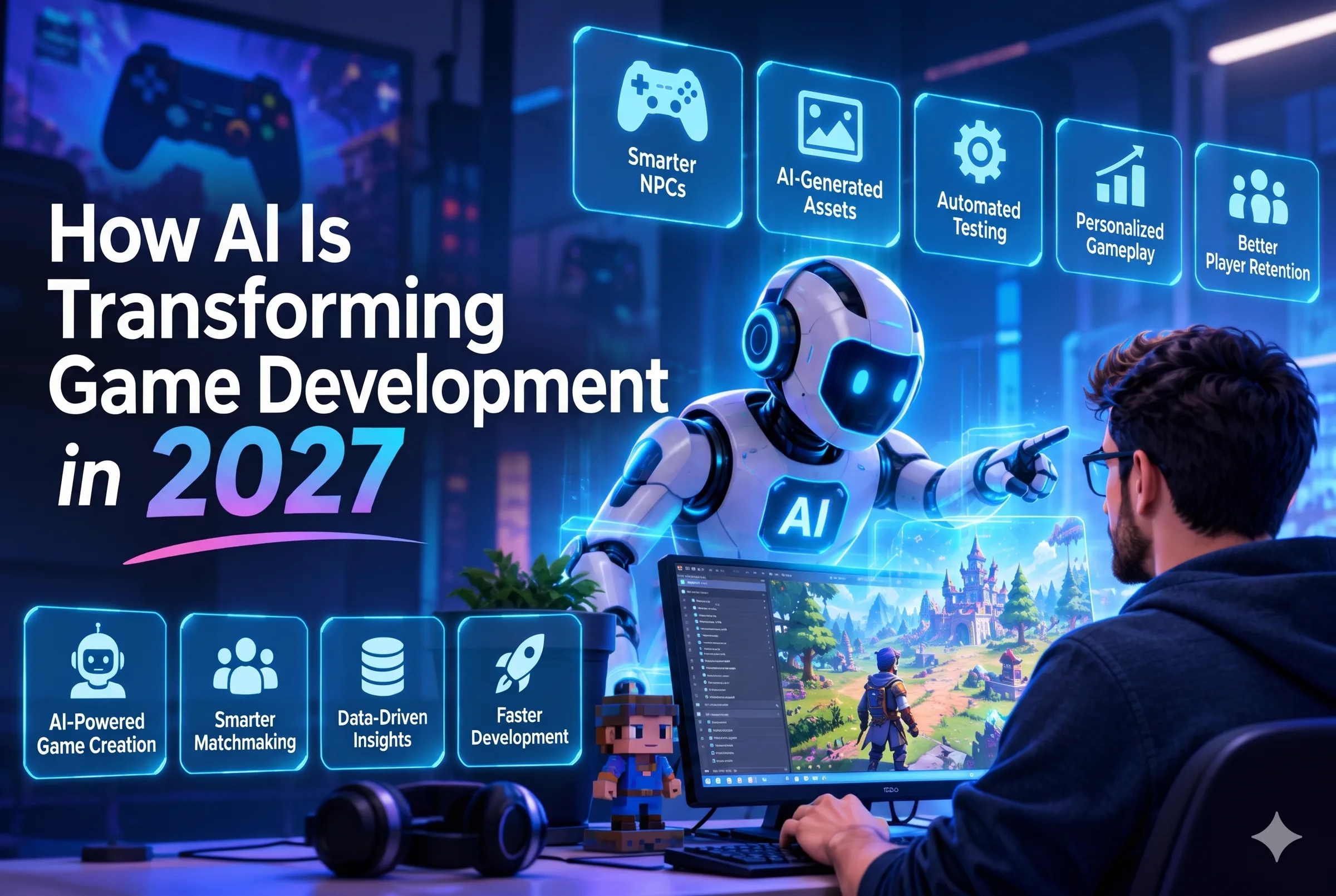
Artificial intelligence is changing how online games are designed, developed, tested and experienced. What once required hours of manual work can now be supported by AI-powered tools that help developers write code, create visual concepts, test gameplay mechanics and understand player behavior.
In 2027, AI game development is becoming an important part of modern game production. Studios are exploring ways to use artificial intelligence to speed up repetitive tasks, improve development workflows and build more responsive gaming experiences. From intelligent non-player characters (NPCs) to automated quality testing, AI is influencing almost every stage of the mobile game development process.
However, the technology is not without limitations. Questions around creative ownership, development quality, data privacy and implementation costs remain important considerations for game studios.
For businesses planning to develop a mobile game, multiplayer experience or an entirely new gaming platform, understanding these developments can help identify where AI adds genuine value.
In this guide, we explore how AI is transforming game development in 2027, the technologies behind it, practical applications, benefits, limitations and what businesses should consider before adopting AI-powered solutions.
Key Takeaways
AI is helping game developers automate repetitive development and testing tasks.
Generative AI can support concept development, coding, dialogue creation and asset exploration.
AI-powered NPCs can make interactions more responsive and dynamic.
AI in mobile game development can support player personalization, matchmaking and retention analysis.
Automated testing can help identify bugs, performance issues and gameplay imbalances.
Human creativity, quality control and technical expertise remain essential to building successful games.
Responsible AI implementation requires attention to licensing, privacy, security and player experience.
How Is AI Changing the Game Development Industry in 2027?
AI is moving beyond experimentation and becoming part of everyday game development workflows.
According to the November 2026 State of the Game Industry report by the Game Developers Conference (GDC), 40% of surveyed game industry professionals use generative AI tools as part of their work, compared with 36% in the previous survey. Among professionals using these tools, 57% reported using them daily.
However, adoption does not mean universal acceptance. The same report found that 55% of respondents believe generative AI is having a negative impact on the gaming industry.
These findings highlight an important distinction: developers are increasingly exploring AI, but they remain cautious about how it should be used.
Some of the most practical applications include:
Generating early game concepts and prototypes.
Assisting developers with coding and debugging.
Creating initial visual and audio concepts.
Automating repetitive quality assurance tasks.
Analyzing player behavior and gameplay data.
Supporting personalized gaming experiences.
Improving development planning and production workflows.
The biggest shift is not that AI can independently create every part of a game. It is that development teams can use it to support specific tasks while keeping creative direction and important decisions under human control.
10 Ways AI Is Transforming Game Development in 2027
Artificial intelligence is influencing different stages of game production. Here are ten practical applications that are shaping modern game development.
1. AI-Powered NPCs and Smarter Game Characters
Non-player characters have traditionally followed predefined instructions. Their movements, conversations and reactions were controlled through programmed behaviors, decision trees and other game AI techniques.
Modern AI is introducing more flexible ways to design these interactions.
AI-powered NPCs can be developed to respond to player actions, recognize conversational context and generate more varied dialogue.
For example, imagine a role-playing game where players interact with a shopkeeper. Instead of selecting from three predefined dialogue options, the player could ask questions in natural language and receive responses based on the character's role and the game's storyline.
Potential applications include:
More responsive enemy behavior.
Dynamic conversations with NPCs.
Characters that react to player decisions.
Context-aware companion interactions.
More varied mission and quest experiences.
However, AI-driven characters need proper boundaries. Developers must control dialogue, prevent inappropriate responses and ensure that generated interactions remain consistent with the game's world.
A hybrid approach, combining scripted character behavior with AI-generated responses, can offer a better balance between flexibility and control.
2. Faster Game Development Through AI-Assisted Coding
Programming is one of the areas where AI tools can provide practical assistance to development teams.
AI coding assistants can help developers understand unfamiliar code, generate basic scripts, identify potential errors and prepare repetitive programming tasks.
For example, a developer working on a mobile puzzle game might use an AI coding assistant to:
Generate an initial scoring system.
Draft basic player movement scripts.
Explain programming errors.
Suggest improvements to existing code.
Create test cases for specific game mechanics.
These capabilities can reduce time spent on routine tasks and allow developers to concentrate on gameplay systems, performance and technical architecture.
However, AI-generated code is not automatically production-ready. Developers must review it for correctness, security, compatibility and performance before integrating it into a game.
For businesses, AI-assisted coding can improve development efficiency, but it does not eliminate the need for experienced game programmers.
3. AI-Generated Game Art, Characters and Environments
Visual production is another area where AI is changing development workflows.
Game artists can use generative AI to explore different visual directions, prepare concept references and create initial asset variations.
Instead of manually exploring every possible visual idea, an artist can use AI-assisted tools to generate references for different environments, character appearances, textures and artistic styles.
Some practical applications include:
Early character concept exploration.
Environment and background references.
Texture and material variations.
Visual mood boards.
Prototype artwork.
Initial animation and audio concepts.
For example, when developing a fantasy adventure game, an art team might explore several environment styles before selecting the final visual direction.
AI can help accelerate this exploration, while professional artists refine the selected concepts and ensure visual consistency.
It is important to check the licensing and usage rights of generated assets, especially when they are intended for commercial game releases.
4. Procedural Content Generation for More Varied Gameplay
Procedural content generation (PCG) uses algorithms and predefined rules to create game content rather than requiring every element to be manually designed.
This technique has existed for years, but machine learning and generative AI are creating additional possibilities.
Developers can use procedural systems to generate:
Game levels and maps.
Randomized environments.
Challenges and missions.
Items and collectibles.
Terrain variations.
Different gameplay scenarios.
Consider a puzzle game with hundreds of levels. A procedural generation system can create new level combinations while following predefined difficulty and gameplay rules.
AI can also help analyze generated content and identify patterns that may make a level too difficult, repetitive or unbalanced.
The important part is validation. Automatically generated content must still be tested to ensure that it is enjoyable, playable and consistent with the intended game design.
5. Automated Game Testing and Quality Assurance
Testing is an essential part of game development, particularly when a game needs to work across multiple devices, operating systems and hardware configurations.
Traditional testing involves developers and QA professionals manually checking gameplay, identifying bugs and verifying different scenarios.
AI-assisted testing can help automate some of this work.
For example, automated testing agents can be designed to:
Navigate through game environments.
Repeat gameplay actions.
Identify unexpected crashes.
Test different player paths.
Detect inaccessible areas.
Highlight performance issues.
Identify potential gameplay imbalances.
For mobile game developers, this can be especially useful when testing different screen sizes, device configurations and gameplay conditions.
Automated testing does not replace human testers. While software can identify technical problems, human testers are still needed to evaluate whether gameplay feels intuitive, balanced and enjoyable.
6. Personalized Gaming Experiences Through AI
Players have different preferences, skill levels and playing habits. AI can help developers understand these differences and build experiences that respond to individual behavior.
By analyzing appropriate gameplay data, AI-powered systems can support personalization.
For example:
Recommending games based on previous activity.
Adjusting difficulty within predefined limits.
Suggesting relevant challenges.
Personalizing in-game events.
Improving matchmaking.
Identifying players who may need additional onboarding support.
In a multiplayer game, matchmaking systems can consider player skill and previous performance to create more balanced matches.
In a casual mobile game, personalization might involve recommending new levels or challenges based on the player's progress.
These features can make games feel more relevant to individual players.
However, personalization should be designed responsibly. Developers must protect player information, avoid intrusive tracking and ensure that recommendations support a positive gaming experience.
7. Better Player Retention Through AI and Game Analytics
Getting players to download a game is only one part of building a successful gaming product. Keeping them interested over time is equally important.
AI can help development teams analyze player behavior and identify patterns that may indicate problems with engagement or retention.
For example, analytics systems can help identify:
Levels where players frequently stop progressing.
Features that receive very little interaction.
Stages where players repeatedly abandon gameplay.
Changes in session duration.
Differences in engagement between player groups.
Based on these insights, developers can improve level design, onboarding, challenges and in-game experiences.
AI-assisted analysis can also help teams identify players who may be at risk of leaving, allowing them to investigate the reasons behind declining engagement.
When combined with well-designed game mechanics, personalization and meaningful rewards, these insights can support stronger player retention.
For more information, explore our guide to the key features of gamification in mobile apps.
8. AI-Assisted Animation, Audio and Dialogue Production
Animation and audio contribute significantly to the overall quality of a game.
Creating character animations, environmental sounds, background music and dialogue can involve considerable production effort.
AI-assisted tools can support parts of this workflow.
Examples include:
Generating initial voice and dialogue references.
Exploring different sound effects.
Supporting animation cleanup.
Creating temporary audio for prototypes.
Preparing dialogue variations.
Helping organize and process audio assets.
Consider a multiplayer adventure game with multiple characters. AI-assisted tools can help the team explore different dialogue styles and prepare early audio references before final production.
Professional review remains important, particularly for character identity, voice performances, sound consistency and commercial usage rights.
9. Smarter Multiplayer Systems and Matchmaking
Multiplayer game development involves more than allowing multiple players to participate in the same match.
Developers must consider matchmaking, game balance, player behavior, server performance and fair competition.
AI can support several of these systems by analyzing gameplay patterns and helping identify suitable matches.
Potential applications include:
Skill-based matchmaking.
Unusual gameplay behavior detection.
Bot and cheating detection.
Player behavior analysis.
Match balancing.
Automated moderation support.
For example, a competitive multiplayer game can use player performance data to group participants with similar skill levels.
This can help create more balanced matches, provided the matchmaking system is carefully designed and tested.
AI can also assist moderation teams by identifying potentially harmful messages or suspicious account activity for further review.
For businesses planning multiplayer products, these systems should be considered alongside the core architecture, networking and backend requirements.
Read our guide to multiplayer game development to understand the technology and systems involved.
10. AI-Powered Game Operations and Post-Launch Management
Game development does not end when an app is published.
Successful games require continuous monitoring, updates, new content and improvements based on player feedback.
AI can help teams manage post-launch operations by analyzing performance data and identifying opportunities to improve the experience.
Some applications include:
Analyzing player engagement.
Identifying technical issues.
Supporting customer service.
Evaluating event performance.
Recommending relevant content.
Monitoring unusual account activity.
For example, a mobile game studio can analyze how players respond to a limited-time event and use those insights when planning future updates.
AI can also support customer service by answering common questions, while more complicated issues are handled by human support teams.
These capabilities can make ongoing game management more data-driven and efficient.
How AI Is Transforming Mobile Game Development
Mobile gaming is one of the most interesting areas for AI adoption because developers must balance gameplay quality, device performance, player engagement and monetization.
AI in mobile game development is not limited to adding intelligent characters or generating game assets. It can also support the systems operating behind the gameplay experience.
Here are some important applications.
Area | How AI can help | Example |
Game design | Explore gameplay concepts | Testing different puzzle mechanics |
Personalization | Adapt experiences | Recommending relevant levels |
Testing | Automate repetitive checks | Testing gameplay across devices |
Analytics | Identify player patterns | Finding levels with high drop-offs |
Matchmaking | Support balanced competition | Matching players by skill |
Content generation | Assist asset exploration | Creating visual references |
Customer support | Handle common queries | Answering frequently asked questions |
Live operations | Analyze event performance | Improving seasonal challenges |
AI in Casual and Puzzle Games
Casual and puzzle games can use AI to support level generation, difficulty analysis and personalized challenges.
For example, an AI-assisted system can help developers evaluate whether a puzzle level is too difficult or whether certain combinations create an unfair gameplay experience.
AI in Multiplayer Mobile Games
Multiplayer games can use AI to support matchmaking, behavior monitoring and player engagement analysis.
Developers can also use automated agents to test different match scenarios before releasing new gameplay features.
AI in Strategy and Simulation Games
Strategy and simulation games often involve multiple interconnected systems.
AI can help create more responsive opponents, generate different scenarios and analyze how players interact with complex gameplay mechanics.
AI in Mobile Gaming Platforms
Platforms that offer multiple games can use recommendation systems to help players discover titles based on their interests and previous activity.
For example, a player who regularly enjoys puzzle games might receive recommendations for similar titles within the platform.
Developers can also analyze which games attract new players and which features encourage continued engagement.
To understand how these experiences fit into the broader industry, read our article on mobile gaming trends to watch in 2027.
Best AI Tools for Game Developers in 2027
AI tools for game developers are becoming increasingly integrated into existing development environments.
Rather than relying on one tool for everything, studios can choose different solutions depending on their production requirements.
Here are some tools and technologies worth exploring.
1. Unity AI Tools
Unity provides AI-assisted development capabilities designed to work alongside its game engine and development workflows.
Its current offerings include an in-editor assistant, an official plugin for coding agents, and tools that allow external agents to interact with Unity through supported development interfaces.
These capabilities can help developers understand project structures, work with code and manage repetitive development tasks.
2. Unity ML-Agents
Unity ML-Agents is an open-source toolkit that allows developers to train intelligent agents using machine learning techniques.
It can be used for:
Training game characters.
Simulating gameplay behavior.
Testing game environments.
Exploring reinforcement learning.
Experimenting with intelligent NPC behavior.
3. GitHub Copilot
GitHub Copilot is an AI-powered coding assistant that supports developers while writing and understanding code.
For game development teams, it can help with:
Writing repetitive code.
Explaining scripts.
Suggesting code improvements.
Debugging assistance.
Preparing test code.
4. ChatGPT
ChatGPT can support different stages of game production, particularly brainstorming, documentation, planning and technical problem-solving.
Game developers can use it to:
Explore game concepts.
Prepare initial game design documents.
Understand programming problems.
Generate prototype scripts.
Develop dialogue drafts.
Organize development requirements.
Generated code and creative content should always be reviewed before being used in a commercial game.
5. Blender
Blender is a 3D creation suite used for modelling, animation, rendering and other production tasks.
Although Blender itself is not simply an AI game development tool, it can be part of an AI-assisted content workflow when combined with suitable plugins and external tools.
Game artists can use it to refine 3D assets, prepare animations and integrate approved visual content into game projects.
Choosing the Right AI Tools
The best AI tool depends on the project, team skills and intended outcome.
A studio developing a 2D puzzle game may need different tools from a team building a large 3D multiplayer experience.
Before selecting a solution, consider:
Compatibility with your game engine.
Integration with existing workflows.
Licensing and commercial usage rights.
Data security and privacy.
Performance and scalability.
Subscription and usage costs.
The level of human review required.
For a broader comparison, explore our guide to the best game development tools in 2027.
Benefits of AI in Game Development
When implemented for the right tasks, artificial intelligence can provide several benefits to game development teams.
Benefit | How it helps |
Faster prototyping | Helps teams explore ideas and mechanics earlier |
Workflow efficiency | Reduces repetitive manual tasks |
Testing support | Expands automated testing possibilities |
Better player insights | Helps identify gameplay and engagement patterns |
Content exploration | Supports early art, dialogue and design concepts |
Personalization | Helps tailor experiences to player preferences |
Development flexibility | Allows teams to experiment with different approaches |
Does AI Reduce Game Development Costs?
AI can help reduce the time spent on certain development activities, but it does not automatically make every game cheaper to produce.
The overall development cost still depends on factors such as:
Game complexity.
Number of features.
Art and animation requirements.
Multiplayer functionality.
Backend infrastructure.
Target platforms.
Testing and maintenance.
AI services may also introduce additional costs through subscriptions, API usage, computing requirements and ongoing infrastructure.
The most effective approach is to evaluate whether a particular AI feature saves enough time or improves the game enough to justify its implementation and operating costs.
For a better understanding of development planning, read our guide on how long it takes to make a mobile game.
Challenges and Limitations of AI Game Development
Despite its potential, AI comes with challenges that developers and businesses should understand before introducing it into a project.
1. Copyright and Intellectual Property
AI-generated artwork, audio, dialogue and code can raise questions about ownership, licensing and training data.
Developers should check the terms of the tools they use and obtain appropriate permissions for commercial assets.
2. Quality and Consistency
AI-generated output may contain errors, inconsistent visual styles or inaccurate information.
Professional developers and artists must review important content before it becomes part of the final game.
3. Data Privacy and Security
AI systems may process sensitive development information or player data.
Studios need clear data-handling policies and should avoid sharing confidential information with external tools without appropriate safeguards.
4. Performance and Infrastructure Costs
AI-powered features, particularly those requiring cloud-based processing, can introduce latency and additional operating costs.
For mobile games, developers must consider device limitations, network conditions and the cost of serving large numbers of players.
5. Player Trust and Transparency
Some players may have concerns about AI-generated characters, artwork, dialogue or other content.
Game studios should consider transparency, creative ownership and the overall quality of the player experience.
6. Overdependence on Automation
Relying too heavily on AI can lead to generic gameplay, repetitive content and technical problems.
AI should support the creative and technical team rather than replace the decisions that make a game distinctive.
How to Integrate AI Into Your Game Development Process
Adding AI to a game should begin with a clear development requirement, not simply because a new tool is available.
A practical implementation process can look like this:
Step 1: Define the game concept
Identify the type of game you want to develop, its target audience, platforms and primary gameplay features.
Step 2: Identify where AI adds value
Decide whether AI is needed for NPC behavior, testing, personalization, analytics, content generation or another specific requirement.
Step 3: Select the right technology
Choose the appropriate AI models, development tools and integrations based on the game's architecture.
Step 4: Build a prototype
Test the proposed AI feature separately before integrating it into the complete game.
Step 5: Evaluate performance and quality
Check accuracy, responsiveness, device compatibility, security and the overall player experience.
Step 6: Integrate AI into the game
Once the feature meets the requirements, integrate it with the gameplay systems and backend infrastructure.
Step 7: Test before launch
Conduct functional, performance, security and gameplay testing.
Step 8: Monitor and improve
After launch, evaluate how players interact with the feature and make improvements based on actual results.
For a more detailed understanding of each development stage, explore our complete guide to the game development process.
What Is the Future of AI in Game Development?
AI game development is likely to become more closely integrated with everyday production tools and gaming experiences.
Rather than treating artificial intelligence as a separate technology, developers will increasingly consider it while planning game mechanics, development workflows and post-launch operations.
Some areas worth watching in 2027 and beyond include:
More Context-Aware NPCs
AI-powered characters may become better at responding to player actions and maintaining more natural conversations.
AI-Assisted Development Environments
Game engines and coding environments are increasingly integrating AI assistants that can understand project context and support developers within existing workflows.
More Automated Game Testing
Automated agents may help teams test more gameplay scenarios and identify issues earlier in production.
Personalized Gameplay Experiences
Developers may use AI-driven analysis to deliver more relevant challenges, content recommendations and gameplay experiences.
AI-Assisted Game Creation
Natural-language interfaces and generative tools are lowering some barriers to early game prototyping. However, producing a complete, polished commercial game still requires technical development, design, testing and optimization.
Greater Focus on Responsible AI
Copyright, privacy, disclosure, data security and player trust will remain important as AI becomes more common in commercial games.
The future will not simply be about using more AI. It will be about choosing the right applications and making sure they improve the final gaming experience.
How GameNexa Can Help With Modern Game Development
Building a successful game requires more than selecting a game engine or integrating the latest technology. It requires a clear concept, thoughtful gameplay design, reliable engineering and a development strategy that supports the product's long-term goals.
GameNexa is a mobile game development company that helps businesses turn gaming ideas into functional digital products.
Whether you are planning a casual mobile game, multiplayer experience, skill-based gaming application or a larger gaming platform, our team can help you plan and develop the right solution.
We focus on understanding the project's requirements before deciding which technologies and features are appropriate.
Our game development approach covers:
Game concept and development planning.
Game design and mechanics.
2D and 3D game development.
Unity-based game development.
Multiplayer game functionality.
Backend and server-side integration.
Testing and performance optimization.
Post-launch support and improvements.
AI can be considered wherever it offers a practical benefit, whether that means assisting development workflows, supporting automated testing or improving selected gameplay features.
Planning to develop a mobile game or a custom gaming platform?
Explore GameNexa and discuss your project requirements with our team.
Frequently Asked Questions About AI Game Development
1. What is AI game development?
AI game development refers to using artificial intelligence, machine learning and related technologies to support the creation and operation of online games. It includes applications such as intelligent NPCs, procedural content generation, automated testing, AI-assisted coding and player analytics.
2. How is AI used in game development?
AI is used for NPC behavior, game testing, coding assistance, concept generation, procedural content, player personalization, matchmaking and gameplay analytics. Developers choose applications based on the requirements of the game.
3. What are the best AI tools for game developers?
Some useful tools and technologies include Unity's AI tools, Unity ML-Agents, GitHub Copilot and ChatGPT. Blender can also support 3D production workflows when combined with suitable AI-assisted tools. The right choice depends on the game engine, development requirements and intended use.
4. Can AI develop a complete mobile game?
AI can assist with several parts of mobile game creation, including code generation, concept exploration, asset development and testing. However, a complete commercial mobile game still requires game design, programming, integration, optimization, quality assurance and human decision-making.
5. How does AI improve mobile game development?
AI can support faster prototyping, automated testing, player analytics, personalized gameplay and matchmaking. These applications can help developers improve production workflows and build more responsive mobile gaming experiences.
6. Does AI reduce game development costs?
AI can reduce the time required for selected repetitive tasks, potentially lowering certain production expenses. However, the overall cost depends on game complexity, development requirements, infrastructure, AI service fees and ongoing maintenance.
7. Will AI replace game developers?
AI is more likely to change development workflows than completely replace skilled game developers. Human expertise remains essential for game design, creative direction, technical architecture, quality control and delivering enjoyable gameplay.
8. Is AI-generated content suitable for commercial games?
It can be, provided developers review the relevant tool licenses, copyright considerations, platform requirements and applicable laws. Commercial use should be evaluated on a case-by-case basis.
9. What is the difference between traditional game AI and generative AI?
Traditional game AI generally uses programmed rules and algorithms to control characters, enemies and gameplay systems. Generative AI creates new content, such as text, images, audio and code, based on patterns learned from training data.
10. What should businesses consider before developing an AI-powered game?
Businesses should define the purpose of AI integration, select appropriate technologies, estimate implementation and operating costs, consider data privacy and licensing, and test the feature before launch. AI should solve a genuine gameplay or development problem rather than be added simply to follow a trend.
Final Thoughts
AI is changing mobile game development by giving studios new ways to approach programming, content production, testing, personalization and player engagement.
In 2027, the most meaningful opportunities will come from using artificial intelligence to solve specific development challenges rather than relying on automation for everything.
For businesses planning a new gaming product, the priority should be to build a strong game concept, select the right technology and identify where AI can improve the experience.
With the right development strategy and experienced team, AI can become a useful part of building engaging, scalable and commercially viable games.