
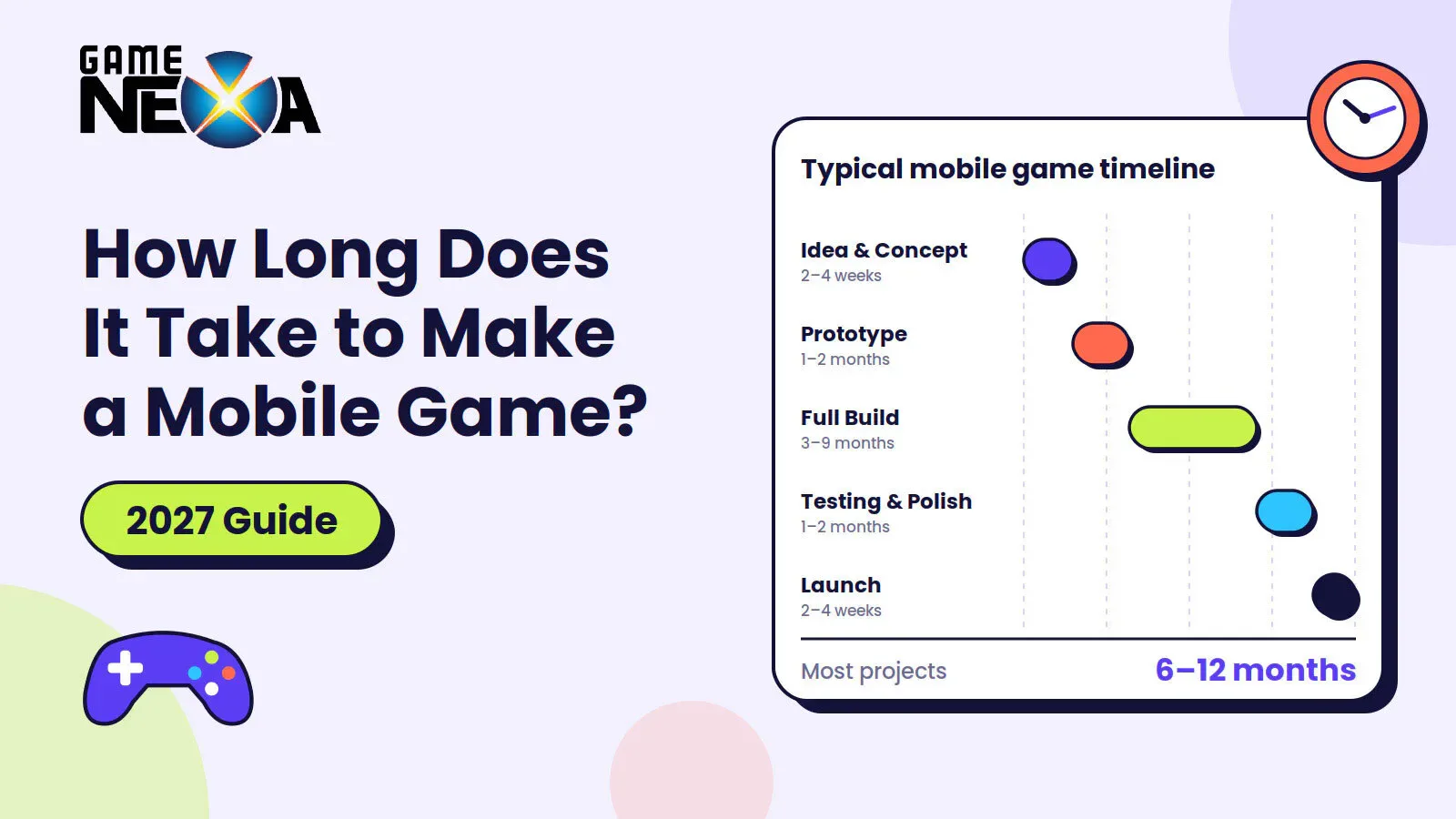
Some mobile games go from idea to app store in eight weeks. Others take three years and still aren’t finished. So how long does it take to make a mobile game? The honest answer is: it depends. But you don’t have to guess. This guide shows real timelines by game type, where the time actually goes, and how to launch faster without cutting corners. Short answer: A simple mobile game takes 1 to 4 months. A mid-size game takes 4 to 12 months. A complex game with multiplayer or 3D art can take 12 to 24 months or more. Most sources agree that a typical mobile game lands somewhere between 6 and 12 months.
Mobile Game Development Time by Game Type
The biggest factor is the type of game. A tap-to-jump game and a multiplayer battle game are very different projects.
Game type | Typical timeline | Examples |
|---|---|---|
Hyper-casual | 1 to 3 months (some ship in 4 weeks) | Tap games, stack games, endless runners |
Casual and puzzle | 3 to 6 months (up to 9 with a backend) | Match-3, word games, simple card games |
Mid-core | 6 to 12 months (up to 18 for large ones) | Strategy, action, RPG-style games |
Multiplayer and PvP | 12 to 24 months or more | Battle arenas, live competitive games |
iGaming and other regulated games | 6 to 12+ months | Casino-style and skill-based games with licensing needs |
These ranges come from several studios and they don’t match exactly. That’s normal. One studio counts the time to a first public release. Another counts the time to a fully polished game. Always ask what ‘done’ means when someone gives you a number.
The 6 Stages of Mobile Game Development
Every mobile game goes through the same basic stages. Here’s how long each one usually takes.
Stage 1: Idea and planning (10 to 15% of the timeline)
You decide what the game is, who it’s for and how it makes money. You also write a game design document, which is the plan for the whole project. For many mobile games this takes one to three weeks. Don’t rush this stage. A clear plan saves months later.
Stage 2: Prototype (1 to 2 months for casual games)
A prototype is a rough, playable version. It has no polish. Its only job is to answer one question: is this fun? One published guide says a minimum viable product (MVP) usually takes 30 to 40% of the full production time. A casual game MVP can be ready in 4 to 6 weeks.
Stage 3: Full production (50 to 60% of the timeline)
This is the big one. Artists create characters, levels and screens. Programmers build the game, the menus, the store and the save system. Sound designers add music and effects. More than half of your total time goes here.
Stage 4: Testing and polish (15 to 20% of the timeline)
Testers look for bugs, crashes and confusing screens. On Android, this includes checking many different phones and screen sizes. Plan for this explicitly. If you don’t, it quietly eats your launch date.
Stage 5: Soft launch (1 to 2 months)
A soft launch means releasing the game in a few test countries first. You watch how players behave. Do they come back? Where do they quit? Then you fix those problems before the global launch. Many teams skip this stage. Most of them regret it.
Stage 6: Launch and updates (never really ends)
Launch day isn’t the finish line. Successful mobile games keep getting new levels, events and balance changes. One studio estimates ongoing work at 10 to 15% of the total timeline, and it continues as long as the game lives.
Example: a 6-month casual game
Here’s how the stages could look for a casual game, from first meeting to store release. It’s an illustration, not a promise.
Stage | Time |
|---|---|
Idea and planning | 2 to 3 weeks |
Prototype | 4 weeks |
Full production | 10 to 12 weeks |
Testing and polish | 4 weeks |
Soft launch and store release | 3 to 4 weeks |
What Makes a Mobile Game Take Longer?
Two games with the same idea can have very different timelines. These are the things that add the most time.
Multiplayer. Real-time multiplayer adds roughly 3 to 6 months to most projects. One studio says it adds 50 to 100% compared to a similar single-player game. The network layer alone can take as long as a small game.
3D instead of 2D. One guide puts a first playable slice at 2 to 3 months for 2D and 4 to 6 months for 3D.
More platforms. Building for iOS and Android from day one adds time. One source estimates about 60% more. A cross-platform engine like Unity helps a lot, but testing still takes time on both.
Lots of content. More levels, characters and items mean more art, more testing and more balancing.
Money systems. Ads are simple. In-app purchases, player accounts, a server and anti-cheat checks all add weeks.
Changing your mind. Scope creep is the number one project killer. Every new feature mid-project moves the date.
Slow approvals. Client projects with many sign-offs and art revisions can take 30 to 50% longer than a small internal project.
Does a bigger team make it faster?
Sometimes, but not as much as you’d expect. Adding people doesn’t cut the timeline in half. New team members need time to learn the project, and more people means more coordination. A small, skilled team with a clear plan often beats a big, messy one. For reference, a solo developer can ship a very simple hyper-casual game in about 6 to 12 weeks. A small team of 2 to 3 people usually needs 6 to 12 months for a mid-size game.
Time and Cost Go Together
Faster usually means a bigger team, and a bigger team costs more. Here’s one published estimate that links the two.
Game category | Timeline | Typical budget |
|---|---|---|
Hyper-casual | 2 to 4 months | $5,000 to $50,000 |
Casual | 6 to 12 months | $50,000 to $500,000 |
Complex mobile | 12 to 18 months | $500,000 to $5 million |
Treat these as rough guides. Budgets vary widely by team location, art style and features. If you want a number for your own idea, ask us for an estimate .
How to Make a Mobile Game Faster
You can’t skip the work. But you can avoid wasted work. These tips help most.
Lock your scope early. Write down the must-have features for launch. Put everything else on a ‘later’ list.
Build the MVP first. Prove the core game is fun before you build the other 90%.
Start with one platform. Launch on Android or iOS first, then expand. Or use a cross-platform engine from the start.
Use a proven engine. Unity and Unreal Engine have ready-made tools that save weeks of coding.
Reuse what already exists. Ready-made modules for login, shops, leaderboards and ads are faster than building from scratch.
Test early and often. A bug found in week 4 costs far less than the same bug found in week 24.
Add a time buffer. Add 15 to 20% to your schedule for surprises. Something always goes wrong.
Choose an experienced team. A team that has shipped mobile games before knows where the traps are.
Common Mistakes That Delay Mobile Games
Trying to build everything at once. Big ideas are great. Big first versions are risky.
Skipping the prototype. Teams that jump straight into full production often find out too late that the game isn’t fun.
Underestimating testing. Phones differ. Screens differ. Networks differ. Testing takes real time.
Forgetting store rules. Both Apple and Google have rules for content, payments, privacy and age ratings. If your game breaks a rule, you’ll need to fix it and submit again. Read the rules before you build, not after.
Ignoring live updates in the plan. Players expect new content. Plan the post-launch roadmap before launch day.
How to Estimate Your Own Game’s Timeline
Want a quick first estimate? Try this.
Pick your game type from the table at the top of this guide and note the range.
List your features. Mark each one as must-have or nice-to-have.
Check the add-ons: multiplayer, 3D, two platforms, accounts or payments. Each one pushes you toward the top of the range or beyond it.
Split the total using the stage percentages: 10 to 15% planning, 50 to 60% production, 15 to 20% testing.
Add a 15 to 20% buffer.
It won’t be exact. But it will be much closer than a guess, and it gives you a solid starting point for talking to a development team.
Why Build Your Mobile Game With Gamenexa
Gamenexa is a game development and iGaming software company with 11 years of experience, 60+ clients and 200+ projects delivered. We help founders and studios go from idea to live game with a clear plan and honest timelines. What you get:
A clear schedule. We break your project into stages with dates, so you always know where you stand.
Experience across game types. From simple casual games to multiplayer and iGaming products.
Honest advice. If a feature will add two months, we tell you before you build it.
Support after launch. Updates, fixes and new content to keep players coming back.
Ready to plan your game? Explore our game development services or talk to our team about your idea.
How long does it take to make a simple mobile game?
A simple mobile game, like a hyper-casual or basic puzzle game, usually takes 1 to 3 months with a small team. Some very small projects ship in about 4 weeks.
How long does it take one person to make a mobile game?
A solo developer can often finish a very simple game in 6 to 12 weeks. A bigger game takes much longer alone, because one person has to design, code, make the art and test everything.
Can you make a mobile game in a month?
Yes, but only a very simple one. A one-month game needs one core mechanic, minimal art, ready-made assets and a very small scope. It's a great way to test an idea, but it won't be a polished, long-lasting product.
How long does it take to make a mobile game for iOS and Android?
It depends on how you build it. With a cross-platform engine like Unity, you share most of the code, so the extra time is mostly for testing and store setup. If you build two separate native apps, the timeline can grow by about 60%, according to one studio.
How long does it take to make a multiplayer mobile game?
Expect 12 to 24 months for a full multiplayer game. Real-time networking adds roughly 3 to 6 months to a project, plus extra time for server setup and testing.
How long does it take to get a mobile game approved on the App Store and Google Play?
Store review is usually quick, but it isn't instant, and it can take longer if your game is rejected and you need to resubmit. Send your game for review early and leave a few days of buffer before your launch date.
Why do mobile games take longer than planned?
The most common reasons are scope creep, late changes, underestimated testing and unexpected technical problems. A good plan has a buffer for these.
Final Thoughts
So, how long does it take to make a mobile game? A simple one can take weeks. A complex one can take years. Most land between 6 and 12 months. The best way to stay on schedule is to keep the first version small, test early and plan for updates after launch. Start with a clear scope and a team you trust, and the timeline gets a lot less scary. Ready to get a timeline for your idea? Get in touch with Gamenexa for a free estimate.