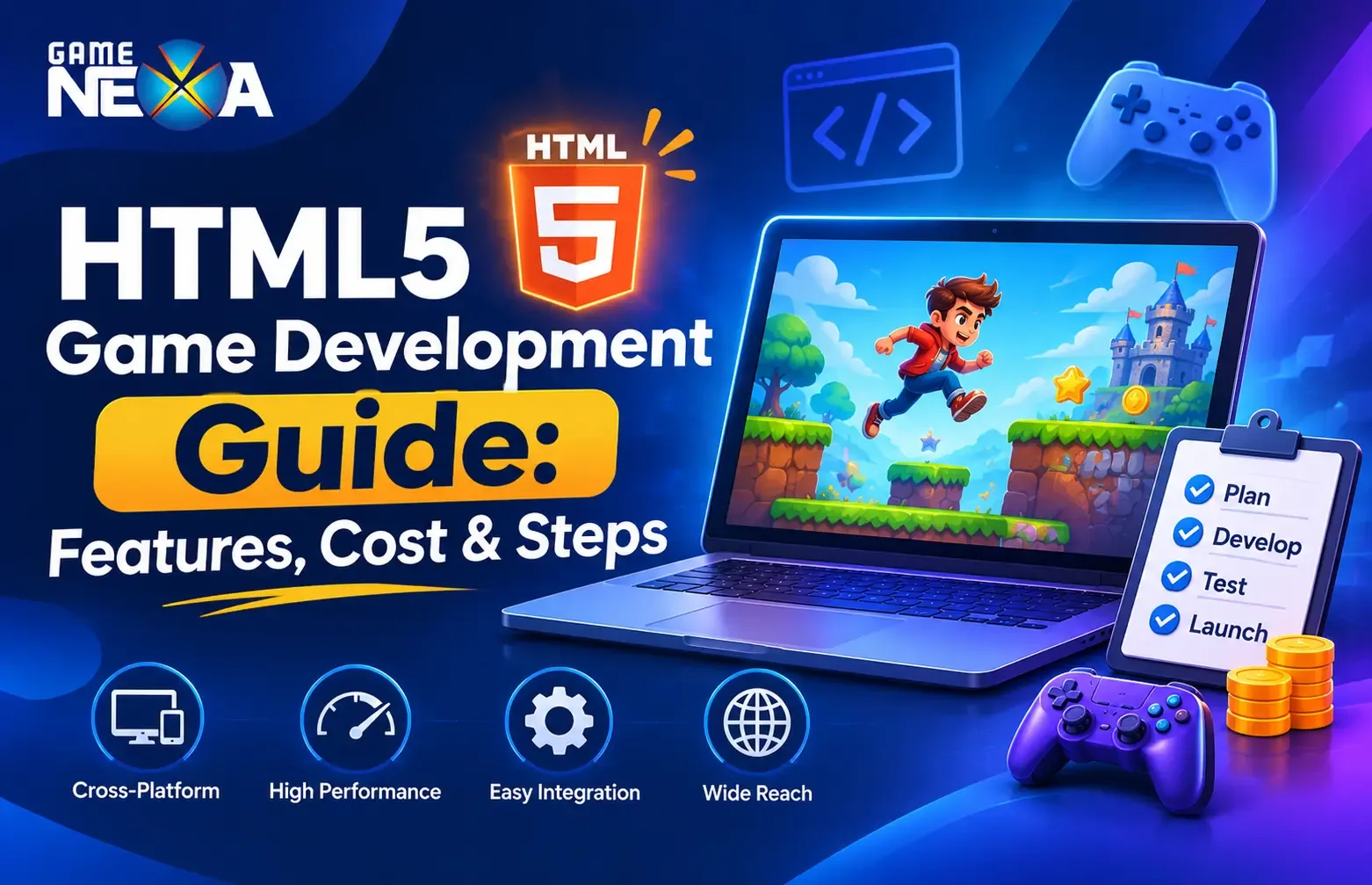
The gaming industry continues to evolve, with players expecting games that are accessible, responsive, and easy to play across different devices. HTML5 game development has become an important approach for creating browser-based gaming experiences without requiring users to download dedicated applications.
This HTML5 Game Development Guide explains how browser-based games are developed, which technologies are involved, and what businesses should consider before starting a project.
Whether you are a startup, gaming entrepreneur, or established business, this guide covers essential features, development steps, technologies, benefits, and costs to help you plan your next gaming project.
What Is HTML5 Game Development? A Beginner’s Guide
HTML5 game development is the process of creating interactive games using web technologies such as HTML5, CSS3, and JavaScript.
These games run directly in compatible web browsers, allowing players to access them without installing a separate application.
HTML5 supports modern browser capabilities, including graphics rendering, audio, animations, and interactive elements. Developers can use these technologies to create different types of gaming experiences.
Common examples include:
Puzzle and casual games
Arcade games
Card and board games
Educational games
Multiplayer browser games
Interactive gaming experiences
One of the biggest advantages of HTML5 games is accessibility. Players can launch a game through a compatible browser on supported desktop and mobile devices.
Types of Games You Can Build with HTML5
HTML5 technology supports several game genres. The right choice depends on your target audience, gameplay concept, and business objectives.
1. Casual Games
Casual games feature simple mechanics and easy-to-understand gameplay. Examples include matching games, tapping games, and basic arcade experiences.
2. Puzzle Games
Puzzle games challenge players through logic, problem-solving, and pattern recognition. Popular formats include block puzzles, word games, and match-based games.
3. Card Games
HTML5 can be used to develop browser-based card games such as Solitaire, Poker, and other multiplayer card experiences.
4. Board Games
Traditional board games can be transformed into interactive browser experiences. Examples include Chess, Ludo, and other turn-based games.
5. Arcade Games
Arcade games focus on quick gameplay, scoring, and player challenges. HTML5 supports lightweight arcade experiences with responsive controls.
6. Multiplayer Games
HTML5 games can support multiplayer functionality through backend systems and real-time communication technologies.
Players can connect, participate in matches, and interact with other users through supported browser environments.
Key Features of HTML5 Game Development
A successful HTML5 game requires more than basic gameplay. The following features help create a complete and engaging gaming experience.
1. Cross-Platform Compatibility
HTML5 games can run across supported browsers and operating systems, reducing the need to develop separate browser versions for every device.
2. Responsive Game Design
Responsive layouts help games adapt to different screen sizes, including smartphones, tablets, and desktops.
3. Interactive Graphics and Animations
Canvas and other browser technologies allow developers to create animations, visual effects, and interactive game elements.
4. Audio Integration
Sound effects, background music, and gameplay notifications can improve the overall gaming experience.
5. Multiplayer Functionality
Backend integration and real-time communication allow developers to create multiplayer experiences where users can play together.
6. Leaderboards and Rewards
Leaderboards, achievements, points, and reward systems encourage players to continue engaging with the game.
7. Social Features
Features such as player profiles, invitations, chat, and sharing options can make browser games more interactive.
8. Analytics and Performance Tracking
Analytics tools help businesses understand player activity, engagement, retention, and gameplay performance.
HTML5 Game Development Guide: Step-by-Step Process
Developing an HTML5 game requires proper planning, design, development, and testing. Here is a typical HTML5 game development process followed by professional development teams.
Step 1: Define the Game Concept
Start by identifying the game genre, target audience, gameplay mechanics, and business objectives.
Decide whether you want to build a casual browser game, puzzle game, card game, or multiplayer experience.
Step 2: Choose the Right Technology
Select suitable technologies based on the game’s requirements.
Common choices include HTML5, CSS3, JavaScript, Canvas, WebGL, and JavaScript game development frameworks.
Step 3: Create UI/UX Designs
Prepare wireframes and visual designs for game screens, menus, buttons, scoreboards, and player interactions.
Focus on intuitive navigation, readable elements, and responsive layouts.
Step 4: Develop Core Gameplay
Implement the main gameplay mechanics, including player controls, game rules, scoring, animations, and interaction systems.
The development team should ensure that gameplay works consistently across supported browsers.
Step 5: Integrate Backend Functionality
If the game requires online features, develop backend systems for player accounts, leaderboards, matchmaking, game sessions, and data management.
For multiplayer games, real-time communication and server-side game validation are particularly important.
Step 6: Optimize Game Performance
Optimize graphics, assets, loading times, and code to ensure smooth gameplay.
Performance optimization is important, particularly for mobile browsers and devices with limited resources.
Step 7: Test the Game
Conduct functional, compatibility, usability, and performance testing.
Test the game across different browsers, screen sizes, operating systems, and network conditions.
Step 8: Launch and Maintain
Deploy the game to the selected hosting environment or gaming platform.
After launch, monitor performance, resolve issues, and introduce improvements based on player feedback.
Technologies Used in HTML5 Game Development
Choosing the right technology stack helps improve game performance, maintainability, and scalability.
Here are some commonly used technologies:
Technology | Purpose |
HTML5 | Game structure and browser capabilities |
CSS3 | Layouts, styling, and animations |
JavaScript | Gameplay logic and interactions |
Canvas API | 2D graphics rendering |
WebGL | Hardware-accelerated 2D and 3D graphics |
Phaser | JavaScript game development framework |
PixiJS | 2D rendering and interactive graphics |
Three.js | 3D graphics and browser-based experiences |
WebSockets | Real-time multiplayer communication |
Node.js | Backend services and server-side functionality |
The final technology selection depends on the game’s complexity, graphics requirements, multiplayer functionality, and expected user traffic.
Benefits of HTML5 Game Development for Businesses
HTML5 offers several advantages for businesses planning to develop browser-based games.
1. Easy Accessibility
Players can access HTML5 games through compatible web browsers without downloading a separate game application.
2. Cross-Device Support
HTML5 supports game experiences across different device types and operating systems through compatible browsers.
3. Faster Distribution
Businesses can publish games through websites and supported gaming portals, making distribution more flexible.
4. Simplified Updates
Developers can update browser-based games on the server without requiring players to download a new application version.
5. Flexible Development
HTML5 technologies support different genres, gameplay mechanics, and interactive experiences.
6. Reduced Installation Barriers
Players can start playing directly through a browser, reducing the steps required to access a game.
HTML5 Game Development Cost: What Should You Expect?
The cost of HTML5 game development depends on the game’s complexity, design requirements, gameplay mechanics, backend functionality, and development timeline.
A simple casual game generally requires less development effort than a multiplayer game with custom graphics, advanced animations, and server-side functionality.
Here are the major factors that influence development costs:
Cost Factor | Impact on Cost |
Game Complexity | Complex gameplay requires additional development work. |
UI/UX Design | Custom interfaces and animations increase design effort. |
Graphics and Assets | Detailed visual assets require more production resources. |
Multiplayer Features | Real-time communication and synchronization add complexity. |
Backend Development | Accounts, leaderboards, and databases require server-side development. |
Platform Compatibility | Additional browser and device testing increases effort. |
Maintenance | Updates, bug fixes, and performance improvements require ongoing support. |
How can you estimate your project budget?
Start with a clear game concept and feature list. Identify the target devices, gameplay requirements, and backend functionality.
An experienced game development company can review these requirements and provide a more accurate project estimate.
HTML5 Game Development vs Native Game Development
HTML5 and native game development serve different purposes. Understanding their differences can help businesses choose the right approach.
Comparison | HTML5 Game Development | Native Game Development |
Accessibility | Runs through compatible browsers | Usually installed as an application |
Installation | No separate installation required | Installation generally required |
Distribution | Websites and supported gaming portals | App stores and other distribution channels |
Updates | Can be deployed centrally | Usually requires application updates |
Device Support | Browser and device compatibility dependent | Platform-specific development |
Performance | Depends on browser and device capabilities | Can offer deeper platform-level optimization |
Offline Support | Possible with additional implementation | Generally more straightforward to implement |
The best approach depends on product requirements, target audience, gameplay complexity, and distribution strategy.
How to Choose the Right HTML5 Game Development Company?
Choosing the right development partner is important for building a quality browser-based gaming product.
Consider the following factors before selecting a company.
1. Technical Expertise
Check the company’s experience with HTML5, JavaScript, Canvas, WebGL, and relevant game development frameworks.
2. Game Development Portfolio
Review previous projects to understand the team’s experience with casual games, puzzles, card games, and multiplayer experiences.
3. UI/UX Capabilities
A good development partner should understand how to create responsive interfaces and intuitive gameplay experiences.
4. Performance Optimization
Ensure the team understands browser compatibility, asset optimization, loading performance, and mobile browser limitations.
5. Backend and Multiplayer Experience
If your project includes online gameplay, choose a team with experience in backend development, real-time communication, and server architecture.
6. Post-Launch Support
Look for a company that can provide ongoing maintenance, updates, performance improvements, and feature enhancements.
Why Choose GameNexa for Game Development?
GameNexa Studios is a game development company founded in 2017, helping businesses turn gaming concepts into digital products.
With 60+ experts and experience across 200+ projects, GameNexa supports businesses with game design, Unity development, multiplayer functionality, and backend integration.
Our development capabilities include:
Mobile Game Development: Building engaging games for Android and iOS.
Multiplayer Game Development: Developing interactive gaming experiences with online player functionality.
Casino Game Development: Creating customized casino-style gaming experiences.
Puzzle and Casual Games: Developing accessible and engaging gameplay experiences.
Card and Board Games: Building digital versions of popular card and board games.
For HTML5-specific requirements, businesses can discuss their browser compatibility, web technology, and project architecture needs with our team to determine the appropriate development approach.
Frequently Asked Question
What is HTML5 game development?
HTML5 game development is the process of creating browser-based games using technologies such as HTML5, CSS3, and JavaScript. These games run through compatible web browsers.
Which programming language is used for HTML5 game development?
JavaScript is the primary programming language used for HTML5 game development. HTML5 and CSS3 support the game's structure and visual presentation.
Can HTML5 games run on mobile devices?
Yes. HTML5 games can run on compatible mobile browsers. Responsive design helps adjust gameplay and interface elements to different screen sizes.
Which framework is best for HTML5 game development?
Phaser and PixiJS are popular choices for 2D HTML5 game development. Three.js is commonly used for browser-based 3D graphics. The right framework depends on the project requirements.
Can HTML5 games support multiplayer functionality?
Yes. HTML5 games can support multiplayer functionality through backend servers, WebSockets, matchmaking systems, and real-time communication.
How much does HTML5 game development cost?
The cost depends on gameplay complexity, graphics, features, backend requirements, and testing needs. A detailed project scope is required for an accurate estimate.
Are HTML5 games suitable for businesses?
Yes. HTML5 games can be useful for gaming businesses, entertainment platforms, educational products, and brands looking to offer interactive browser-based experiences.
How long does it take to develop an HTML5 game?
The timeline depends on the game's complexity, features, design requirements, and backend infrastructure. Simple games generally require less time than complex multiplayer projects.
Conclusion: HTML5 Game Development Guide
HTML5 game development provides businesses with a flexible way to create accessible browser-based gaming experiences.
From casual puzzles and arcade games to interactive card games and multiplayer experiences, HTML5 technologies support a wide range of gaming concepts.
This HTML5 Game Development Guide highlights the important aspects of planning, designing, developing, and launching a browser-based game.
However, building a successful game requires the right technology stack, engaging gameplay, responsive design, performance optimization, and proper testing.
If you are planning to enter the browser gaming market, understanding these elements can help you make better development decisions and build a product that meets your business objectives.
Ready to Build Your Next Gaming Experience?
Looking to develop an engaging browser-based game or explore new gaming opportunities?
GameNexa Studios brings game development experience, technical expertise, and creative execution together to help businesses build customized gaming products.
Let’s discuss your project and explore the right development approach.